Screening and tests
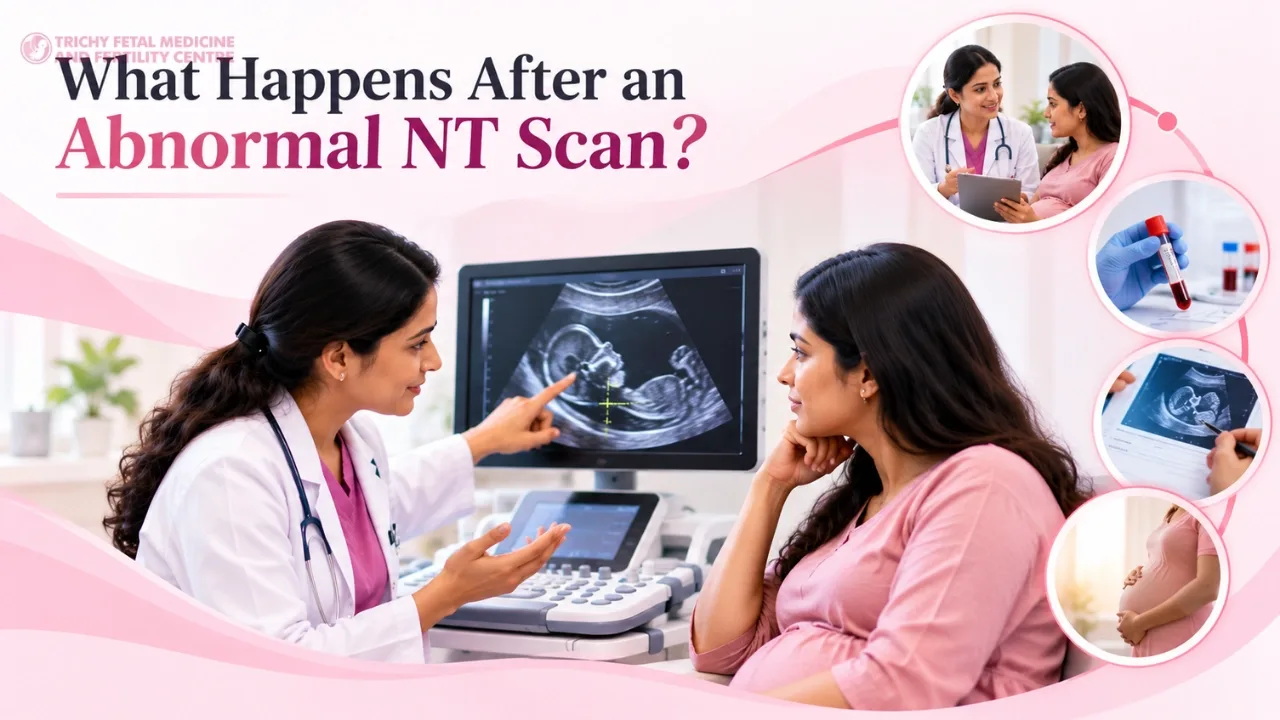
What Happens After an Abnormal NT Scan?
An abnormal NT scan raises a question and does not give a final answer. Here is how doctors usually work through it, step by step.
Reviewed24 October 20268 min read

NIPT is a blood test used during pregnancy to screen for certain chromosome conditions, particularly Down syndrome. Learn when NIPT is done, what it can detect, its limitations, and what to do after a high-risk result.
If you have been offered an NIPT during pregnancy, it is quite normal to have questions before deciding whether to take it.
What exactly does the test look for? Is it safe for the baby? How early can it be done? If the result says “high risk,” does that mean the baby definitely has a genetic condition?
The short answer is that NIPT is a screening test, not a diagnostic test. It analyses small fragments of placental DNA found in the mother's blood and estimates the chance of certain chromosome conditions in the pregnancy. It is particularly useful for screening for trisomy 21 (Down syndrome), trisomy 18 and trisomy 13. Current professional guidance considers cell-free DNA screening to be the most sensitive and specific screening method for these common fetal aneuploidies.
NIPT can generally be performed from 10 weeks of pregnancy. A low-risk result substantially reduces the chance of the conditions being screened for, but does not eliminate it. A high-risk result needs further assessment and, when confirmation is required, diagnostic testing such as chorionic villus sampling (CVS) or amniocentesis.
That distinction matters. A blood test can estimate risk; it cannot, by itself, establish a diagnosis.
NIPT stands for Non-Invasive Prenatal Testing.
It is also commonly called:
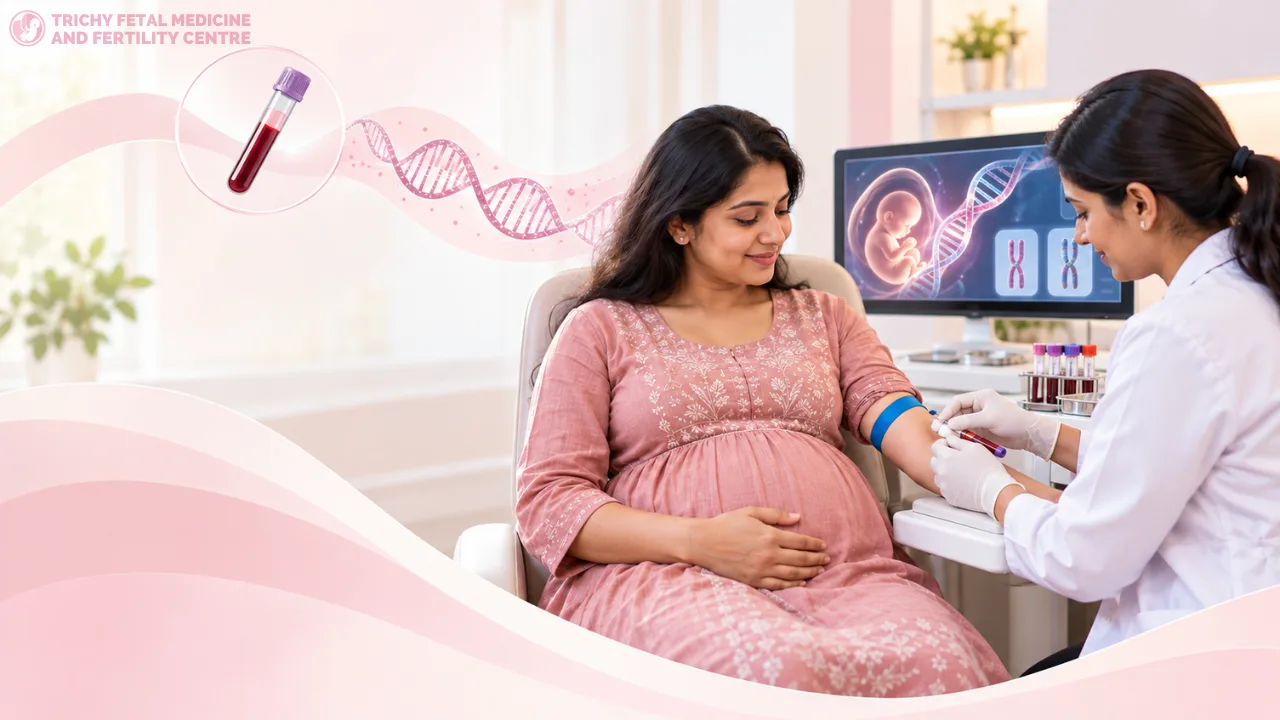
During pregnancy, fragments of DNA from the placenta circulate in the mother's bloodstream. A blood sample taken from the mother can therefore provide information about the chromosome pattern associated with the pregnancy.
The test does not require a needle to enter the uterus. It is performed using a maternal blood sample.
That is one reason NIPT has become an important option in prenatal screening.
However, the name can sometimes create confusion. “Non-invasive” refers to how the sample is collected. It does not mean that NIPT provides a definitive diagnosis.
NIPT can generally be performed from 10 weeks of pregnancy.
Testing earlier than the recommended gestational age may result in an insufficient amount of placental DNA being available for analysis.
The exact timing can depend on the laboratory, pregnancy circumstances and the type of test being offered. Before testing, it is useful to confirm:
NIPT is therefore not simply a matter of having a blood sample taken. Understanding what the particular test covers is an important part of the decision.
The main purpose of NIPT is screening for certain fetal chromosome conditions.
The most established targets are:
Trisomy 21 occurs when there is an additional copy of chromosome 21.
NIPT is particularly effective at screening for trisomy 21 and is considered the most sensitive and specific screening test for this common aneuploidy.
Trisomy 18 is associated with significant fetal abnormalities and can affect multiple organ systems.
NIPT can screen for an increased chance of trisomy 18.
Trisomy 13 is another chromosomal condition that can cause significant fetal abnormalities.
NIPT can also screen for an increased chance of trisomy 13.
Some NIPT panels also offer screening for differences involving the sex chromosomes.
This part of testing is somewhat different from screening for trisomies 21, 18 and 13. Current SMFM guidance recommends that sex chromosome aneuploidy screening be offered as an opt-in after appropriate pre-test counselling.
Whether this information is included, and which conditions are covered, depends on the specific test.
No.
This is one of the most important limitations to understand before having NIPT.
NIPT is designed to screen for particular chromosome conditions. It does not screen for every genetic disease, every chromosome abnormality or every fetal structural problem.
For example, NIPT does not replace:
Some laboratories also offer screening for rare microdeletions or other uncommon genetic conditions. Routine population screening for microdeletion conditions using cfDNA is not recommended by SMFM. When a patient wants definitive information about fetal copy-number variants, diagnostic testing may be more appropriate.
This is why choosing an NIPT should involve understanding exactly what is being tested rather than simply looking at the number of conditions included on a laboratory package.
The placenta releases small fragments of DNA into the mother's bloodstream. These fragments are commonly referred to as cell-free DNA.
A blood sample is collected from the mother and sent to the laboratory.
The laboratory analyses the available DNA fragments and looks for patterns associated with an increased or decreased likelihood of particular chromosomal conditions.
The important point is that the DNA being analysed is largely derived from the placenta.
Because the placenta and fetus generally have the same genetic makeup, the test can provide useful information about the pregnancy.
But they are not always genetically identical.
Conditions such as placental mosaicism can sometimes affect the result. Other circumstances can also lead to a false-positive, false-negative or non-reportable result.
That is one reason NIPT remains a screening test.
No. NIPT is a screening test.
This distinction should be clear before interpreting the report.
A screening test estimates the probability that a particular condition is present.
A diagnostic test attempts to establish whether the condition is actually present.
For prenatal diagnosis, procedures such as:
may be used when clinically appropriate.
Therefore:
Low-risk NIPT ≠ complete guarantee that the baby is unaffected.
High-risk NIPT ≠ confirmed diagnosis.
The result has to be interpreted together with the pregnancy history, ultrasound findings and, where appropriate, diagnostic testing.
There is no single accuracy percentage that can accurately describe every NIPT result.
The performance of the test varies according to:
For common fetal aneuploidies such as trisomy 21, 18 and 13, professional guidance considers cfDNA to be the most sensitive and specific screening approach currently available.
But “highly accurate” does not mean “diagnostic.”
This is especially important when interpreting a positive or high-risk result.
A test can have excellent sensitivity and specificity and still produce false-positive results, particularly when the condition being screened for is uncommon in the individual pregnancy.
That is why the positive predictive value, or PPV, also matters.
Positive predictive value refers to the likelihood that a person with a positive screening result actually has the condition being screened for.
This depends partly on the underlying probability of the condition.
For example, two women could receive the same type of high-risk screening result, but the chance that the result represents a true fetal condition may not be identical because their baseline risks and clinical circumstances may differ.
This is one reason it is better not to interpret an NIPT report using a generic statement such as:
“NIPT is 99% accurate, so a high-risk result means the baby has the condition.”
That interpretation is incorrect.
The actual report needs to be reviewed in context.
A low-risk result means that the screening test found a lower likelihood of the chromosome conditions included in the test.
This can provide considerable reassurance.
However, it does not mean that every possible genetic condition has been excluded.
Nor does it replace ultrasound assessment.
A pregnancy with a low-risk NIPT result still requires appropriate routine antenatal care and ultrasound evaluation.
If a later ultrasound identifies a structural abnormality, the pregnancy may need further assessment despite an earlier low-risk NIPT.
In other words:
NIPT answers one question. It does not answer every question about fetal health.
A high-risk result means that the screening test has identified an increased likelihood of a particular chromosome condition.
It does not mean that the diagnosis is confirmed.
This is an important moment, and the next step should generally be a proper review rather than an immediate decision based only on the laboratory report.
A high-risk result may sometimes occur because of factors other than an affected fetus. These can include biological differences between placental and fetal DNA and other maternal or pregnancy-related factors.
SMFM recommends appropriate counselling following high-risk cfDNA results, and diagnostic confirmation should be considered when definitive information is needed.
Receiving a high-risk result can be frightening, especially if the report is read without clinical explanation.
The next step is usually not to assume the diagnosis.
A fetal medicine specialist or an appropriately trained clinician may review several pieces of information together.
The exact chromosome finding, test methodology and laboratory report should be examined.
Not every “high-risk” result has the same clinical meaning.
Your age, gestational age, pregnancy type, previous screening and other relevant factors may influence interpretation.
Ultrasound can provide additional information about fetal anatomy and may identify findings that alter the overall assessment.
However, a normal ultrasound does not necessarily rule out a chromosome condition.
Genetic counselling can help explain:
If definitive information is required, CVS or amniocentesis may be discussed.
These tests obtain fetal/placental material directly for chromosome analysis and are diagnostic procedures rather than screening tests.
The purpose of this process is to avoid making major pregnancy decisions based solely on a screening result.
Yes.
A high-risk NIPT may be one of the reasons diagnostic testing is offered.
The choice between CVS and amniocentesis depends on factors such as:
Your fetal medicine specialist can explain the potential benefits and risks of each procedure.
The important principle is that NIPT should not be treated as a substitute for diagnostic confirmation when confirmation is required.
A high-risk NIPT should not automatically be treated as proof of a fetal diagnosis.
This is particularly important when a decision would have major or irreversible consequences.
Professional guidance emphasizes the distinction between screening and diagnostic testing. A positive cfDNA result should be followed by appropriate counselling and diagnostic testing when confirmation is needed.
The goal is not to create unnecessary anxiety. It is to make sure that important decisions are based on the strongest information reasonably available.
No.
NIPT and NT assessment provide different types of information.
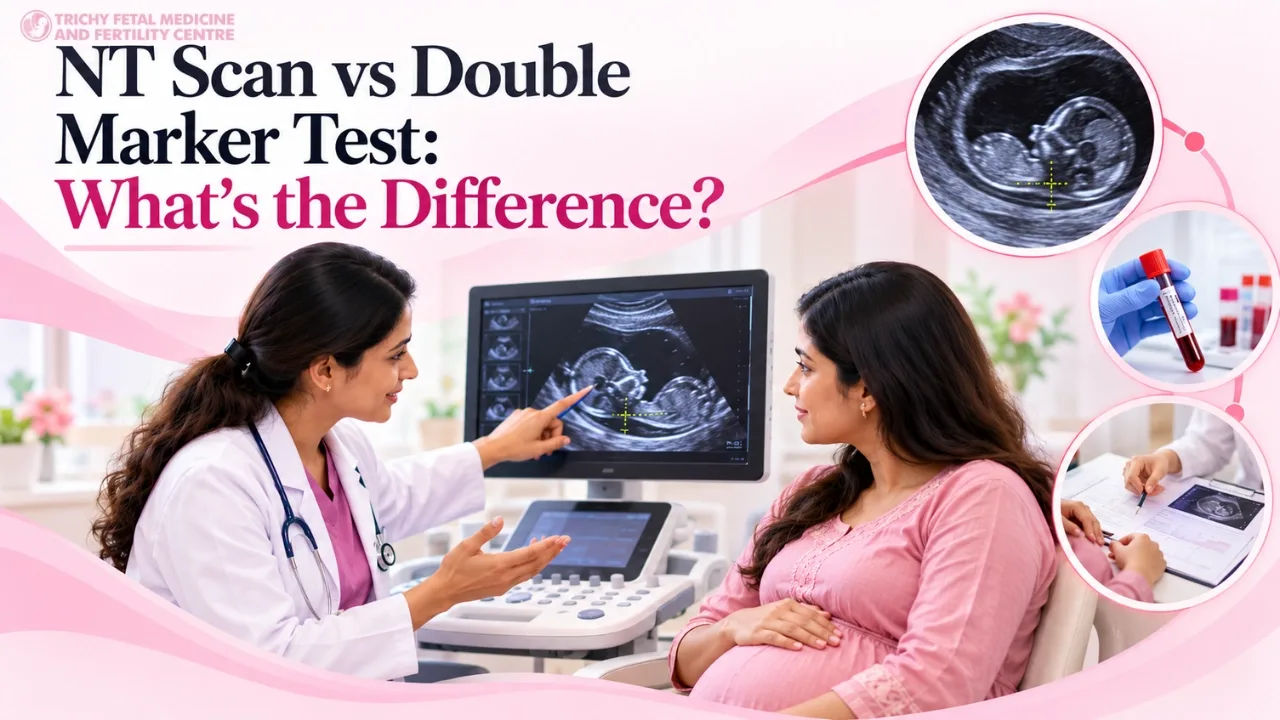
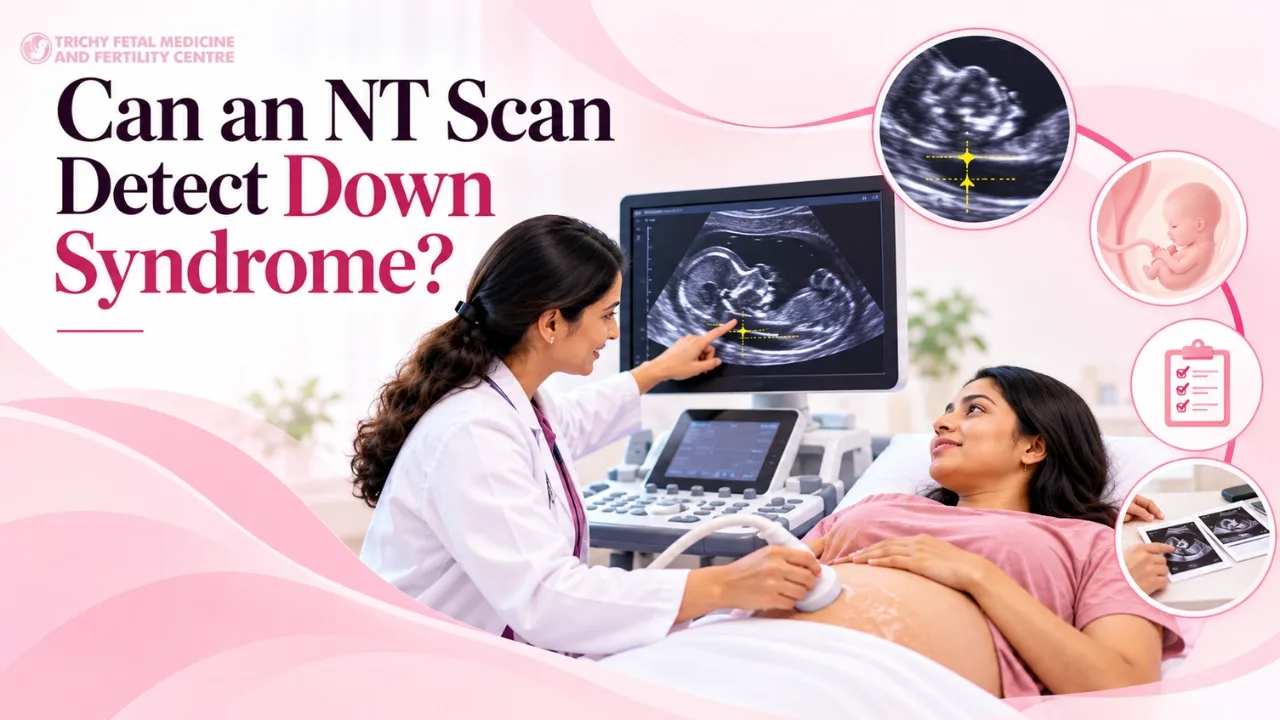
| NIPT | NT Scan |
|---|---|
| Blood-based screening test | Ultrasound assessment |
| Analyses cell-free DNA | Measures nuchal translucency and assesses the fetus |
| Primarily screens for selected chromosome conditions | Provides information about chromosomal risk and fetal development |
| Can be performed from around 10 weeks | Usually performed during the first-trimester ultrasound window |
| Does not provide a full anatomical assessment | Provides ultrasound information about fetal anatomy and early development |
NIPT: Blood-based screening test
NT Scan: Ultrasound assessment
NIPT: Analyses cell-free DNA
NT Scan: Measures nuchal translucency and assesses the fetus
NIPT: Primarily screens for selected chromosome conditions
NT Scan: Provides information about chromosomal risk and fetal development
NIPT: Can be performed from around 10 weeks
NT Scan: Usually performed during the first-trimester ultrasound window
NIPT: Does not provide a full anatomical assessment
NT Scan: Provides ultrasound information about fetal anatomy and early development
NIPT vs NT Scan: Are They the Same?
These tests should not automatically be viewed as competitors.
In many pregnancies, ultrasound remains an essential part of care even when NIPT has been performed.
The Double Marker Test is part of conventional first-trimester screening and uses maternal blood markers together with ultrasound and other clinical information.
NIPT uses cell-free DNA to screen specifically for certain chromosomal conditions.
The two approaches are therefore based on different biological information.
Current professional guidance considers cfDNA the most sensitive and specific screening test for the common fetal aneuploidies.
However, choosing a screening strategy is not simply about asking which test is “better.” Cost, availability, gestational age, pregnancy type, previous testing, ultrasound findings and personal preferences can all matter.
A fetal medicine consultation can help determine which approach is appropriate for an individual pregnancy.
Pregnancies conceived through IVF can also be offered prenatal genetic screening and diagnostic testing.
Importantly, having undergone preimplantation genetic testing does not automatically eliminate the need to discuss prenatal screening or diagnostic testing during pregnancy.
SMFM recommends that patients who have achieved pregnancy through IVF be offered options for prenatal genetic screening and diagnostic testing, even when preimplantation genetic testing has been performed.
The appropriate approach depends on the type of preimplantation testing performed and the circumstances of the pregnancy.
NIPT can be used in twin pregnancies, but interpretation is different from that in singleton pregnancies.
Current SMFM guidance recommends cfDNA as a first-line screening option for trisomy 21 in twin pregnancies. Screening for trisomy 18 and trisomy 13 is also recommended, although the number of affected twin pregnancies available for study is more limited.
Some forms of cfDNA screening are not recommended in higher-order multiple pregnancies because evidence is insufficient.
Twin pregnancies also introduce additional considerations, including:
For this reason, a twin pregnancy should not simply be treated as a singleton pregnancy with “two babies.”
Sometimes the laboratory cannot provide a reportable result.
This may be described as:
There are several possible reasons.
The test may have been performed too early, there may not have been enough placental DNA in the sample, or maternal and pregnancy-related factors may have affected the result.
A non-reportable result should not simply be ignored.
SMFM's updated guidance specifically addresses the management of inconclusive cfDNA results and recommends appropriate counselling and further evaluation.
Depending on the circumstances, your doctor may discuss repeat screening, ultrasound assessment or diagnostic testing.
No.
This is one of the most common misconceptions about NIPT.
NIPT mainly provides information about selected chromosome conditions.
The anomaly scan evaluates fetal anatomy.
A detailed ultrasound can assess structures such as:
A fetus can have a structural abnormality even when NIPT indicates a low risk for the chromosome conditions being screened.
For this reason, prenatal genetic screening and fetal anatomical assessment serve different purposes.
NIPT can miss or does not evaluate many conditions.
Depending on the test, this may include:
A low-risk NIPT therefore should never be interpreted as a general statement that the fetus is completely healthy.
It means the likelihood of the specific conditions screened by that test is reduced.
NIPT can be discussed with pregnant patients as part of prenatal genetic screening.
Current guidance recommends that screening for common aneuploidies be routinely available to obstetrical patients.
A discussion about NIPT may be particularly useful when:
The decision to undergo screening remains a personal one.
Before giving a blood sample, consider asking:
Different laboratories offer different panels.
Most standard cfDNA screening begins from around 10 weeks.
Singleton and multiple pregnancies may require different considerations.
Ask where you would receive counselling and whether diagnostic testing is available.
This is worth discussing before testing rather than after receiving an inconclusive report.
If it does, ask what evidence supports those additional findings and how they would be followed up.
Yes. NIPT does not replace routine fetal ultrasound or the anomaly scan.
A fetal medicine consultation can be particularly useful if:
The value of specialist counselling is not limited to interpreting a report. It is about putting the result into the context of the whole pregnancy.
For women seeking fetal medicine care in Trichy, prenatal screening should be approached as part of the wider pregnancy assessment rather than as an isolated laboratory test.
At Trichy Fetal Medicine & Fertility Centre, fetal medicine services include Down syndrome screening, NIPT, anomaly scanning, genetic counselling, fetal echocardiography, second-opinion scans and other specialised prenatal procedures.
When a screening result raises concern, the next step may involve a combination of ultrasound assessment, counselling and, when appropriate, diagnostic testing.
The centre's listed services include procedures such as amniocentesis and CVS, which may be considered when definitive prenatal diagnosis is required.
Patients often search for “NIPT test cost” before deciding where to have the test.
However, there is no single universal price.
The cost can vary depending on:
A cheaper test is not necessarily equivalent to another test with a broader panel.
Before comparing prices, compare what the test actually covers.
NIPT is a powerful prenatal screening tool, but it is still a screening test.
Think of the process in three steps:
NIPT → estimates risk
Diagnostic testing → confirms or excludes certain conditions
Ultrasound → evaluates fetal development and anatomy
These are complementary parts of prenatal care rather than interchangeable tests.
A low-risk NIPT result can be reassuring, but routine pregnancy care and ultrasound remain important.
A high-risk NIPT result needs careful interpretation and, when appropriate, diagnostic confirmation.
And if the result is inconclusive, that also deserves proper medical follow-up rather than simply being treated as a failed test.
NIPT has changed the way many chromosome conditions are screened for during pregnancy. It offers an early, non-invasive way of assessing the likelihood of certain chromosomal conditions, particularly Down syndrome.
But the value of the test lies not just in the blood sample or the number printed on the report.
The interpretation matters just as much.
A low-risk result needs to be understood in the context of the rest of the pregnancy. A high-risk result needs careful counselling and, when appropriate, diagnostic confirmation. An inconclusive result also deserves proper follow-up.
If you are considering NIPT, or have already received a result that you are unsure how to interpret, discussing it with a fetal medicine specialist can help you understand what the result means and what options are available next.
You can read about how we run the NIPT at our centre, and who performs it, on the team page.
This guide is for general information and does not replace a consultation with a fetal medicine specialist.
In line with the PCPNDT Act, we do not perform or support sex determination.
NIPT
A simple blood test from the mother that screens for common chromosomal conditions, with no risk to the baby.
Card 1 of 3
Call us, message us on WhatsApp, or send a request and our team will call you back to schedule your visit.
Mon - Fri: 9:00 AM - 9:00 PM