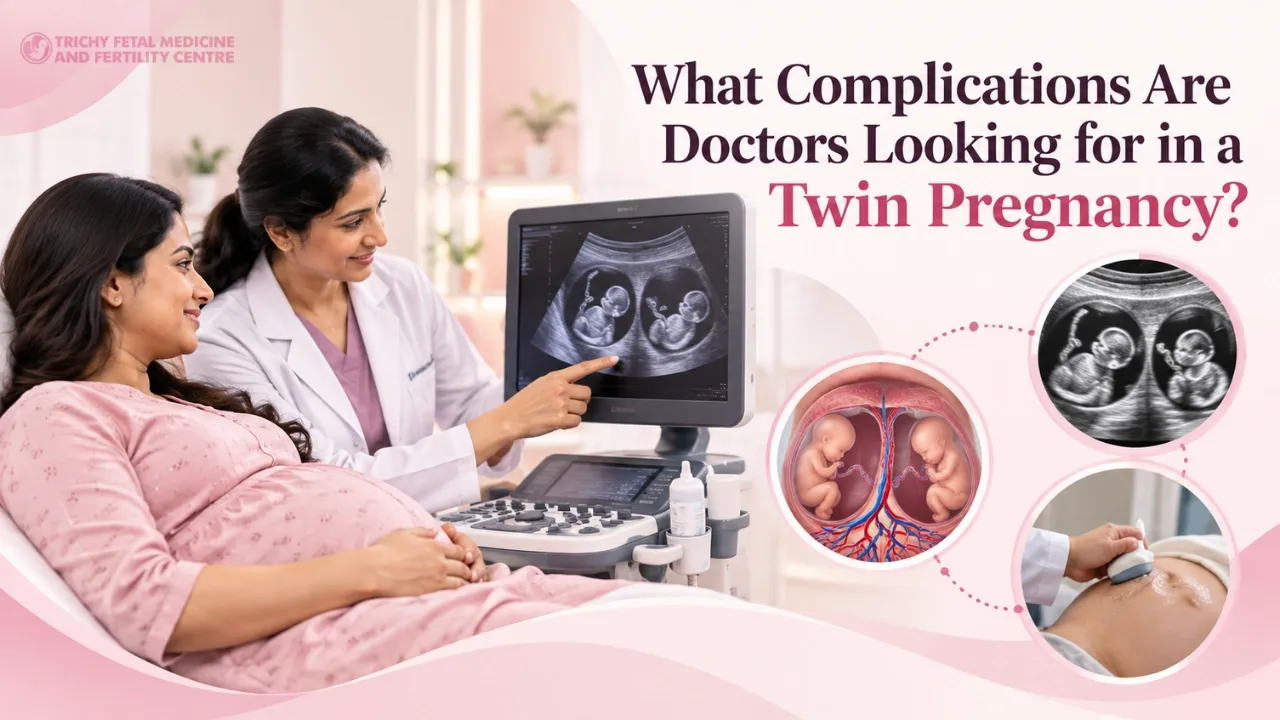
Twin Pregnancy: Scans, Risks, Monitoring & What Parents Need to Know
Whether your twins share a placenta decides most of your scan plan. Here's what that means, what each scan looks for, and when a fetal medicine specialist steps in.
Most parents hear the word "twins" on an early scan and leave with two questions: are the babies okay, and what happens now? The short version is that twin pregnancies need more frequent checks than a single pregnancy, and the number of checks depends on one detail the scan picks up in the first trimester. That detail is whether the babies share a placenta.
This article walks through that first scan, the ones that follow, the complications doctors look for, and how the timing of birth is decided.
What is a twin pregnancy?
It is simply a pregnancy with two babies. How those two babies came about, though, affects how they share space and blood supply in the uterus.
Non-identical twins come from two eggs fertilised by two sperm. Each has its own placenta and its own sac, and genetically they are no more alike than any other siblings.
Identical twins come from one fertilised egg that splits. If the split happens early, they end up with separate placentas. If it happens a little later, they share one.
So when your doctor talks about your twins, "identical or not" matters less than a more practical question: how many placentas are there, and how many sacs?
Twins are more common now than a few decades ago. Part of the reason is that more women are having babies later, and part is IVF, where transferring more than one embryo raises the chance of twins.
How are twins detected on ultrasound?
Usually on an early dating or viability scan, when two sacs or two heartbeats show up. Occasionally a very early scan misses the second baby, or shows a second sac that doesn't go on to develop. That's why the picture is confirmed on a scan a few weeks later, somewhere between 11 and 14 weeks.
Stronger morning sickness or a bump that seems big for dates can make people wonder about twins. Neither is reliable. Only a scan can tell you.
What are chorionicity and amnionicity, and why do they matter?
Chorionicity tells you whether the twins share a placenta. Amnionicity tells you whether they share a sac, the bag of fluid each baby floats in. Between them, these two findings decide which complications are possible and how often you'll be scanned. If you remember one thing from your first-trimester scan, make it this.
Dichorionic diamniotic (DCDA) twins
Two placentas, two sacs. All non-identical twins fall in this group, along with some identical twins. Each baby has its own blood supply, so the problems caused by a shared circulation don't arise.
Monochorionic diamniotic (MCDA) twins
One placenta, two sacs. These twins are always identical. On the surface of the shared placenta, blood vessels link one baby's circulation to the other's. Most of the time the flow stays balanced. When it doesn't, problems can develop, which is why these pregnancies are scanned more often.
Monochorionic monoamniotic (MCMA) twins
One placenta and one sac, with no membrane between the babies. This is rare. With both babies in the same space, their cords can become tangled, and these pregnancies are followed very closely by specialists.
When should chorionicity be checked?
The 2025 ISUOG guideline on twin pregnancy advises confirming it before 13 weeks and 6 days. The sonographer looks at where the dividing membrane meets the placenta, how thick that membrane is, and how many placental masses can be seen.
Two signs come up often in reports. The lambda sign, sometimes called the twin peak sign, is a small wedge of placenta running up into the membrane, and it usually points to separate placentas. The T sign, where a thin membrane meets the placenta at a right angle, usually points to a shared one.
The same guideline recommends saving an image of this in your records, and getting a second opinion from a specialist centre if it can't be worked out. It gets harder to tell as the pregnancy goes on, so this early window really does count.
What happens at the first-trimester twin scan?
A fair amount gets done at the 11 to 14 week scan. Your due date is set from the babies' measurements, or from the embryo transfer or egg collection date if you conceived through IVF. Chorionicity and amnionicity are confirmed. Each baby is given a label, such as Twin 1 and Twin 2, based on where they lie, so that later scans follow the same baby each time. Some major structural problems can already be seen, and if you choose screening for chromosomal conditions like Down syndrome, that is usually offered now too.
How does screening for Down syndrome work in twins?
A screening test gives you a likelihood. It doesn't give you a yes or no.
For twins, screening may use the NT (nuchal translucency) measurement of each baby, blood tests, or cell-free DNA testing, commonly called NIPT. The ISUOG guideline describes cell-free DNA, available from 10 weeks, as the most accurate screening option for trisomy 21 in twins. It is still a screening test. A high-chance result is a reason for a conversation with a specialist, and possibly a diagnostic test, not a diagnosis in itself.
Diagnostic tests such as CVS (chorionic villus sampling) and amniocentesis can confirm whether a chromosomal condition is there. With twins, the doctor has to be sure each baby is sampled correctly, so these are generally done in a fetal medicine unit. Genetic counselling before and after testing can help you think through what the results might mean for your family.
How often do you need scans in a twin pregnancy?
This comes back to chorionicity.
If your twins have separate placentas and all is going well, you'll typically have the first-trimester scan, a detailed anomaly scan at about 20 weeks, and then growth scans around every four weeks.
If your twins share a placenta, scans usually start every two weeks from 16 weeks and continue that way until birth. The reason is twin-to-twin transfusion syndrome, which tends to appear between 16 and 26 weeks and can change within a couple of weeks. Seeing you often gives the best chance of spotting it early, when treatment works better.
If something is found, the gap between scans shortens. Your own schedule may also differ because of your history or earlier findings.
What does each follow-up twin scan check?
Each baby is assessed on their own, and then the two are compared.
The sonographer measures the head, tummy and thigh bone to estimate each baby's weight, then works out the percentage difference between them. That figure, called discordance, is recorded at every scan from 20 weeks. The fluid around each baby is measured as well. In MCDA twins, a big mismatch in fluid between the two sacs can be the first hint of TTTS.
Doppler is part of the same ultrasound, not a separate procedure, and it measures blood flow. The umbilical artery Doppler shows how well the placenta is supplying each baby. ISUOG suggests starting it at 20 weeks in twins who share a placenta and at 24 weeks in twins who don't. In shared-placenta twins, doctors also check blood flow speed in a vessel in each baby's brain, the middle cerebral artery, from 20 weeks. This picks up TAPS, a condition where one twin becomes anaemic.
At the anomaly scan, your cervix will usually be measured too. A short cervix can flag a higher chance of very early birth.
What is the anomaly scan like in a twin pregnancy?
The anomaly scan, also called the TIFFA or 20-week scan, looks at each baby's brain, face, spine, heart, tummy, kidneys and limbs. With twins it takes longer, and the babies don't always lie in a helpful position, so you may be asked to walk around or come back.
Twins who share a placenta have a slightly higher chance of some structural problems, heart conditions included, so the heart gets careful attention. Sometimes a separate fetal echocardiogram, a dedicated heart scan, is suggested.
A normal anomaly scan is reassuring, but no ultrasound picks up every condition, and it can't promise that both babies will be born healthy.
What are the risks of a twin pregnancy?
Plenty of twin pregnancies are uneventful. The risks below explain why the care plan looks the way it does.
Risks for the mother
Carrying two babies asks more of your body. High blood pressure and pre-eclampsia are more likely, and so are gestational diabetes and anaemia. Early nausea and vomiting are often worse. Bleeding after birth tends to be heavier, and a caesarean is more often needed.
Routine antenatal visits, blood pressure checks and blood tests exist to catch these early. Your obstetrician may also prescribe supplements or preventive medicine depending on your risk. Stick to what's prescribed for you rather than general advice.
Risks for the babies
Being born early is the biggest one, and babies born very early may need time in the neonatal unit. One or both babies may also grow less than expected, since the placenta, or placentas, has to support two. Sometimes one twin is noticeably smaller than the other. And as mentioned, twins sharing a placenta have a slightly higher chance of structural problems.
Being called "high risk" doesn't mean something will go wrong. It means you benefit from being watched more closely.
What complications affect twins who share a placenta?
A handful of problems only happen when twins share a placenta, because of those connecting vessels. These are the reason for two-weekly scans.
Twin-to-twin transfusion syndrome (TTTS)
In TTTS, blood moves unevenly between the babies. One twin, the donor, gives away more than it gets back and ends up with very little fluid around it. The other, the recipient, takes in too much and has excess fluid.
It affects roughly 10 to 15% of monochorionic twin pregnancies and is diagnosed on ultrasound, mostly from the difference in fluid. The standard treatment is fetoscopic laser surgery, which seals the connecting vessels on the placenta and is done in specialist fetal medicine centres. Whether it's the right option depends on the stage of TTTS and how far along the pregnancy is.
Selective fetal growth restriction (sFGR)
Here one twin grows much less than the other, usually because the placenta isn't shared equally. Doctors follow the size gap and the blood flow in the smaller baby's cord. Many of these pregnancies are simply watched more closely. Some need a specialist discussion about other options.
Twin anaemia-polycythaemia sequence (TAPS)
With TAPS, very small connecting vessels let blood trickle from one twin to the other over time. One baby becomes anaemic and the other has too many red blood cells. There's no big fluid difference like in TTTS, so it can be missed without the brain blood flow check.
Twin reversed arterial perfusion (TRAP) sequence
A rare condition where one twin has no working heart and is kept going by the other twin's circulation. The healthy "pump" twin's heart is under strain. In selected cases, a procedure such as radiofrequency (RF) ablation may be offered to stop the blood flow to the non-viable twin and protect the pump twin.
Cord entanglement in monoamniotic twins
When twins share a sac, their cords can wrap around each other. This is one reason MCMA twins are watched so carefully and delivered earlier than other twins.
What happens if one twin dies during pregnancy?
It's uncommon, and many parents find it hard to ask about. With separate placentas, the surviving twin is usually less affected. With a shared placenta, the surviving twin can be affected too, so a specialist needs to assess them. Families going through this need emotional support alongside the medical care.
What happens if a complication is found on a twin scan?
It's natural to feel frightened when a scan shows something unexpected. A first finding doesn't always turn out to be serious, and further assessment is often what clarifies things.
What follows depends on the finding. You might be scanned more often, with Doppler. You might be referred to a fetal medicine specialist, or offered a fetal echocardiogram if the heart is in question. Genetic counselling and diagnostic testing may come up. In some situations, fetal treatments like laser therapy or RF ablation will be discussed, and the obstetric and newborn teams will start planning when and where the babies should be born.
These decisions are rarely simple. You should come away from a specialist appointment understanding what the options are, what each one might offer, what it risks, and what is still uncertain, so you can choose what's right for your family.
When are twins usually delivered?
Earlier than single babies, because the risk of stillbirth starts rising sooner in twin pregnancies. How much earlier depends, again, on chorionicity.
In the UK, NICE recommends offering planned birth at 37 weeks for uncomplicated twins with separate placentas, at 36 weeks for uncomplicated twins sharing a placenta but in separate sacs, and between 32 and 33+6 weeks for uncomplicated twins sharing both, after steroid injections for the babies' lungs have been considered. Other countries' guidelines differ a little, and any complication can change the plan.
Whether you can have a vaginal birth depends on how the first twin is lying, the type of twin pregnancy, any previous caesareans, and how the pregnancy has gone. When the first twin is head-down, vaginal birth is often possible. MCMA twins, or a first twin lying breech, are among the situations where a caesarean is more likely to be advised. Your obstetrician will talk this through with you as you get closer to the date.
When should you seek urgent medical attention?
Don't wait for your next scan. Call your obstetrician or go in to be seen if you have vaginal bleeding, fluid leaking from the vagina, or regular tightenings, period-like cramps or low backache before 37 weeks. In a pregnancy where the twins share a placenta, a sudden increase in the size of your bump, a tight feeling across it, or new breathlessness also needs checking promptly. Later in pregnancy, get help if the babies' movements slow down or change.
A bad headache, blurry vision, sudden swelling of your face, hands or feet, or pain under your ribs can be signs of pre-eclampsia, and these need urgent assessment too.
How can you look after yourself during a twin pregnancy?
Keep every antenatal appointment and scan, including the ones when you feel perfectly fine, because many twin complications cause no symptoms early on. Eat well, and take the iron, folic acid or other supplements your doctor recommends. Tiredness hits harder with twins, so rest when you can, and keep moving in ways that feel comfortable unless you've been told otherwise.
It helps to keep your scan reports together, especially the one that records chorionicity, and bring them to every visit. And if the worry is getting to you, say so. Expecting twins comes with extra anxiety for many parents, and talking it through with your doctor or someone close to you does help.
When should you see a fetal medicine specialist for a twin pregnancy?
Many uncomplicated pregnancies with separate placentas are looked after by an obstetrician with regular scans. A fetal medicine specialist is more likely to be involved if your twins share a placenta, if chorionicity couldn't be confirmed, or if the babies differ noticeably in size or fluid. Referral is also common when screening raises a structural or chromosomal concern, when TTTS, TAPS, sFGR or TRAP is suspected, when one twin has died, or when a procedure like CVS, amniocentesis or fetal treatment is being considered.
What questions can you ask at your twin scan?
Start with the basics: do my twins share a placenta, and do they share a sac? Then ask how often you'll need scans and what each one is checking. It's worth asking at every visit whether there's any difference in size or fluid between the babies. Before you leave, find out which symptoms should make you call before your next appointment. Later on, ask when and how the babies are likely to be born.
Twin pregnancy care in Trichy
For families in Trichy and nearby parts of Tamil Nadu, Trichy Fetal Medicine and Fertility Centre runs a specialised twin clinic. The centre also offers first-trimester screening, anomaly scans, growth scans with Doppler, fetal echocardiography and genetic counselling, along with CVS and amniocentesis. Fetal interventions, including fetoscopic procedures and RF ablation for selected twin pregnancies, are also available. Specialist care here works alongside your own obstetrician.
If you've just found out you're having twins, the most practical step is to make sure your chorionicity is written clearly in your report and that you know which scan plan goes with it. The extra appointments can feel like a lot, but they exist so that any problem is caught while there's still time to act.
If a twin scan has raised a question, talk it over with your obstetrician or a fetal medicine specialist. Families looking for twin pregnancy care in Trichy can reach Trichy Fetal Medicine and Fertility Centre through https://fmctrichy.com/.
If your doctor has suggested this, our twin specialised clinic page lists what is included and how to book; the team is happy to talk it through first.