Screening and tests
What Happens After an Abnormal NT Scan?
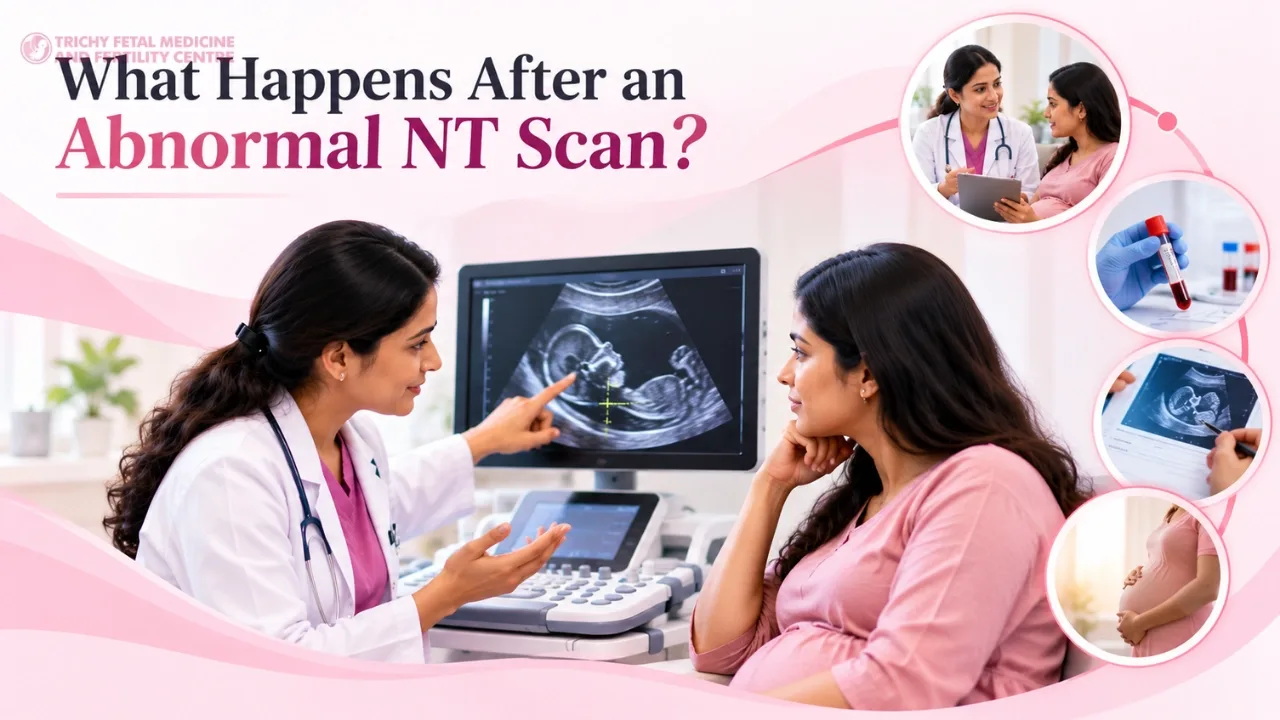
An abnormal NT scan raises a question and does not give a final answer. Here is how doctors usually work through it, step by step.
Reviewed24 October 20268 min read
An NT scan is an early pregnancy ultrasound that measures fluid behind the baby's neck and helps assess the risk of certain chromosomal and structural conditions.

An NT scan in pregnancy, or nuchal translucency scan, is an ultrasound examination performed during the first trimester. It measures the fluid-filled space behind the baby's neck and forms part of prenatal screening for certain chromosomal conditions.
The scan is usually performed between 11 weeks and 13 weeks + 6 days, when the baby's crown-rump length is approximately 45 to 84 mm. The timing matters because the NT measurement changes as the fetus grows, so the number needs to be interpreted according to the baby's size and gestational age.
One thing often causes unnecessary worry: an increased NT measurement does not mean that the baby definitely has Down syndrome or another abnormality. NT is a screening marker. It changes the estimated risk and may lead to further assessment, but it is not a diagnosis.
So what exactly does the scan measure? What is considered normal? And if the result is higher than expected, what happens next?
Let's look at each of these questions in practical terms.
NT stands for nuchal translucency.
During early pregnancy, a small amount of fluid can normally be seen beneath the skin at the back of the fetal neck. On ultrasound, this appears as a translucent space. The NT scan measures that space.
The measurement is taken in a specific fetal position and using a standardized ultrasound technique. This matters because the fetal position and the quality of the image can affect the measurement.
NT is useful because differences in the measurement can be associated with an increased chance of certain chromosomal conditions and some structural abnormalities.
But an NT scan is not designed to answer one simple question, "Is my baby healthy?"
It provides one piece of information that has to be considered alongside the rest of the first-trimester assessment.
The usual window for a standardized NT measurement is:
11 weeks to 13 weeks + 6 days
The fetal crown-rump length should generally be between 45 mm and 84 mm.
This is not simply a matter of choosing any appointment during the first trimester. NT interpretation depends on fetal size as well as gestational age.
That is why a scan performed too early or outside the appropriate fetal size range may not provide a standardized NT assessment.
If you are approaching the end of the first trimester and have been advised to have an NT scan, it is worth discussing the timing with your obstetrician or fetal medicine specialist rather than delaying the appointment unnecessarily.
The fetus changes rapidly during the first trimester.
The amount of fluid seen behind the neck is not expected to remain exactly the same throughout this period. A measurement therefore has to be compared with what is expected for the baby's particular stage of development.
For the same reason, simply hearing a number such as "3 mm" or "3.5 mm" without knowing the gestational age and fetal size does not tell the whole story.
A properly performed NT assessment takes these factors into account.
This is one of the most searched questions about the test, but it does not have a single-number answer.
NT measurements are interpreted in relation to fetal size and gestational age.
In many clinical settings, an NT measurement around 3 to 3.5 mm or above may be considered increased. However, the exact interpretation depends on the gestational age, crown-rump length, measurement technique and the overall ultrasound findings.
Some resources describe most NT measurements as being below approximately 3.5 mm during the appropriate first-trimester window. That does not mean that every measurement above or below a particular number automatically has the same clinical significance.
A specialist should interpret the measurement in context.
Imagine two patients receiving slightly different measurements.
One report might show an NT of 2.8 mm. Another might show 3.2 mm.
Those numbers cannot be interpreted properly without knowing:
That is why an NT report should be discussed as a complete assessment rather than reduced to one number.
NT is useful because an increased measurement can be associated with several types of fetal conditions.
These include:
At the same time, an increased NT can occur in a pregnancy in which subsequent investigations are reassuring.
That is why the wording "increased risk" is more appropriate than assuming that an abnormality has already been found.
Down syndrome, or trisomy 21, occurs when a fetus has an additional copy of chromosome 21.
An increased NT can be associated with a higher likelihood of Down syndrome. However, measuring NT does not establish whether the fetus has Down syndrome.
This distinction is worth remembering:
NT screening estimates risk. It does not diagnose Down syndrome.
The NT measurement can be used as part of a broader first-trimester screening assessment. Depending on the screening approach, the calculation may also take into account maternal age, fetal measurements, biochemical markers and other ultrasound findings.
No. An NT scan cannot diagnose Down syndrome by itself.
It can contribute to the assessment of the likelihood of Down syndrome.
If the overall screening result suggests a higher chance, your doctor may discuss additional screening or diagnostic testing.
Diagnostic tests such as chorionic villus sampling (CVS) or amniocentesis are different from screening tests because they are used to determine whether particular chromosomal abnormalities are present.
This is an important distinction for anyone reading a prenatal screening report. A "high-risk" screening result is not the same thing as a confirmed diagnosis.
Yes.
NT contributes to screening for several common chromosomal abnormalities, including:
The measurement can also provide information beyond chromosome screening.
An increased NT may sometimes be associated with structural abnormalities, particularly abnormalities involving the fetal heart.
So an NT scan should not be thought of as simply a "Down syndrome test." It is part of a broader first-trimester fetal assessment.
The nasal bone is one of several ultrasound markers that may be assessed during first-trimester screening.
Its presence, absence or appearance may provide additional information when evaluated using appropriate ultrasound criteria.
Other markers can also be considered in specialist settings, including assessment of tricuspid flow and the ductus venosus.
These findings should not be interpreted individually. Their significance depends on the overall screening assessment and the expertise of the person performing and interpreting the examination.
An increased NT means that the pregnancy may have a higher chance of certain chromosomal or structural conditions compared with pregnancies with a typical measurement.
It does not tell you exactly what is causing the increase.
Depending on the situation, possible explanations may include:
The next step is therefore not to assume the worst. The next step is to find out whether additional information is needed.
No.
This is perhaps the most important point for parents who have received an increased NT result.
An increased NT is a risk marker, not a diagnosis.
Some pregnancies with increased NT go on to have reassuring chromosome testing and normal structural assessments.
Other pregnancies may reveal a chromosomal, cardiac or structural condition during subsequent evaluation.
The actual significance depends on the measurement, the fetal development, other ultrasound findings and the results of any additional testing.
There is no single follow-up plan that applies to every patient.
Your doctor may first review the ultrasound carefully and discuss what the measurement means in relation to your baby's size and gestational age.
Depending on the circumstances, further steps may include:
The choice depends on the findings and the individual's circumstances.
An increased NT therefore does not automatically mean that an invasive procedure will be required.
Not necessarily.
Amniocentesis is a diagnostic test, whereas NT is a screening assessment.
If an NT measurement is increased, your doctor may discuss different ways of obtaining more information. These can include additional screening or diagnostic testing.
The decision depends on factors such as:
Genetic counselling can be particularly helpful when several testing options are being considered.
NT and NIPT are sometimes discussed together, but they are not the same test.
NT is an ultrasound measurement.
NIPT, also called cell-free DNA screening, is a blood test that analyses DNA fragments circulating in the mother's blood to screen for certain chromosomal conditions.
They answer different questions.
An ultrasound can provide information about fetal development and structural findings that a blood-based screening test cannot provide.
NIPT, on the other hand, is a highly sensitive screening approach for common fetal aneuploidies, but it remains a screening test rather than a diagnostic test.
This is why NIPT should not be viewed as a replacement for appropriate ultrasound assessment.
The NT scan and the double-marker test are also different components of prenatal screening.
The NT scan uses ultrasound to measure nuchal translucency.
The biochemical component uses maternal blood markers. When combined with clinical and ultrasound information, these measurements can contribute to an overall first-trimester screening risk assessment.
The exact screening pathway varies between patients and healthcare settings.
A doctor may therefore recommend one screening strategy rather than simply ordering every available test.
A low-risk screening result is reassuring, but it does not mean that every possible fetal condition has been excluded.
For example, a normal NT cannot rule out every:
This is why pregnancy screening continues beyond the first trimester.
The second-trimester anatomical ultrasound remains an important part of routine prenatal assessment.
In other words, a reassuring NT result is good news about the particular risks being assessed, but it is not a guarantee that every aspect of fetal health has been checked or will remain normal.
A high-risk screening result means that the estimated chance of a particular condition is higher than the screening threshold.
It does not mean that the condition has been confirmed.
This distinction can become confusing when reports use terms such as:
These terms describe the screening result.
A diagnostic test is what may be used when confirmation is needed.
If you receive a high-risk screening result, your obstetrician or fetal medicine specialist can explain what the result means and what options are available.
Yes.
No screening test detects every pregnancy affected by a chromosomal or genetic condition.
A normal NT reduces concern for some conditions, but it does not eliminate risk completely.
This is one reason screening decisions should be based on the complete clinical picture rather than on NT alone.
Yes.
An increased NT can sometimes be found even when subsequent chromosome testing does not identify a chromosomal abnormality.
In those circumstances, doctors may pay particular attention to fetal anatomy and the heart because increased NT can also be associated with structural abnormalities.
Further assessment may be completely reassuring in some pregnancies.
Again, the meaning of the initial measurement becomes clearer only after the appropriate follow-up.
It can.
An increased NT has been associated with an increased likelihood of congenital heart abnormalities.
This does not mean that an increased NT automatically means there is a heart defect.
If the clinical picture warrants it, a doctor may recommend a more detailed assessment of the fetal heart later in pregnancy.
A fetal echocardiogram is a specialized ultrasound examination of the fetal heart. It provides a more detailed cardiac assessment than a routine ultrasound when there is a clinical reason to perform it.
The examination is performed using ultrasound.
The sonographer or fetal medicine specialist obtains a suitable fetal profile and measures the nuchal translucency according to standardized criteria.
The baby's crown-rump length is also recorded because it is important for interpreting the NT measurement.
The examination may be performed through the abdomen. Occasionally, a transvaginal approach may be considered when better imaging is needed.
The actual procedure is generally similar to other pregnancy ultrasound examinations.
Yes.
The baby's position matters during an NT examination.
For a standardized measurement, the fetal neck should be in a neutral position. If the neck is excessively extended or flexed, the measurement can be affected.
This is one reason NT screening should be performed by someone appropriately trained in the technique.
A reliable NT result is not simply a matter of placing an ultrasound probe on the abdomen and reading a number from the screen.
Sometimes the fetal position makes it difficult to obtain the correct image.
The sonographer may wait, reposition the mother or use other appropriate techniques to obtain a suitable view.
If a satisfactory measurement cannot be obtained, the healthcare team will decide whether another assessment is needed.
An incomplete measurement should not simply be treated as a normal or abnormal result.
Twin pregnancies need some additional considerations during first-trimester ultrasound.
The scan can help establish:
Chorionicity describes whether the twins share a placenta.
Amnionicity describes whether they share an amniotic sac.
These details matter because twin pregnancies can require different patterns of monitoring depending on whether the twins share a placenta and/or amniotic sac.
The interpretation of prenatal screening in a twin pregnancy can also differ from that in a singleton pregnancy, so the screening plan should be discussed with the treating team.
Being pregnant after IVF does not remove the need to consider prenatal screening.
The same general principle applies: ultrasound assessment and appropriate chromosomal screening provide different types of information.
Depending on the pregnancy, the doctor may discuss first-trimester ultrasound, NIPT/cfDNA screening and other available prenatal testing options.
The fact that conception occurred through IVF should be considered alongside the rest of the patient's clinical history rather than treated as a reason to automatically perform every available test.
Prenatal screening decisions should be discussed with the obstetrician or fetal medicine specialist.
There are several approaches to screening for fetal chromosomal abnormalities, and recommendations may depend on the patient's circumstances, gestational age, available tests and personal preferences.
The important point is not to assume that one test gives the complete picture.
If you are unsure whether an NT scan, NIPT or another form of screening is appropriate, ask your doctor what information each option would provide.
First, don't interpret the result from the number alone.
Look at the complete report and discuss it with the doctor who is caring for your pregnancy.
Useful questions include:
Having these questions answered can make the report much easier to understand.
A fetal medicine consultation may be useful when:
A fetal medicine consultation is not necessarily an indication that something is wrong.
In many cases, the purpose is to obtain a more detailed assessment and explain what the available testing options mean.
Patients in Trichy and Tiruchirappalli who have questions about first-trimester screening, an increased NT measurement or prenatal testing may be referred for fetal medicine assessment.
Trichy Fetal Medicine and Fertility Centre lists services including Down syndrome screening/OSCAR, first-trimester anomaly scans, NIPT, anomaly scans and genetic counselling, alongside other fetal medicine services.
The centre is located at 73, C/9, Annamalai Nagar, Thillai Nagar, Trichy - 620 018.
The purpose of specialist review is to interpret the findings in context and help parents understand what, if anything, needs to happen next.
An NT scan gives doctors useful information at a stage of pregnancy when the fetus is developing rapidly. But the measurement is only one part of the assessment.
If the result is within the expected range, that can be reassuring. If it is higher than expected, it is understandable to have questions. The number itself, however, does not provide a diagnosis.
What matters next is understanding why the measurement is considered increased, what the rest of the ultrasound shows, whether additional screening is useful and whether diagnostic testing should be discussed.
For that reason, an NT report is best interpreted with your obstetrician or fetal medicine specialist rather than by comparing the number with an online "normal range."
When you are ready, the Down's screening (OSCAR) service page covers timings and preparation; questions about your own situation are best put to our specialists.
This guide is for general information and does not replace a consultation with a fetal medicine specialist.
In line with the PCPNDT Act, we do not perform or support sex determination.
Down's Screening (OSCAR)
A combined first trimester screening that assesses the chance of Down's syndrome and other chromosomal conditions.
Card 1 of 3
Call us, message us on WhatsApp, or send a request and our team will call you back to schedule your visit.
Mon - Fri: 9:00 AM - 9:00 PM