Screening and tests
What Happens After an Abnormal NT Scan?
An abnormal NT scan raises a question and does not give a final answer. Here is how doctors usually work through it, step by step.
Reviewed24 October 20268 min read

The NT scan is an ultrasound and the double marker is a blood test. Learn how doctors read the two together in first-trimester screening.
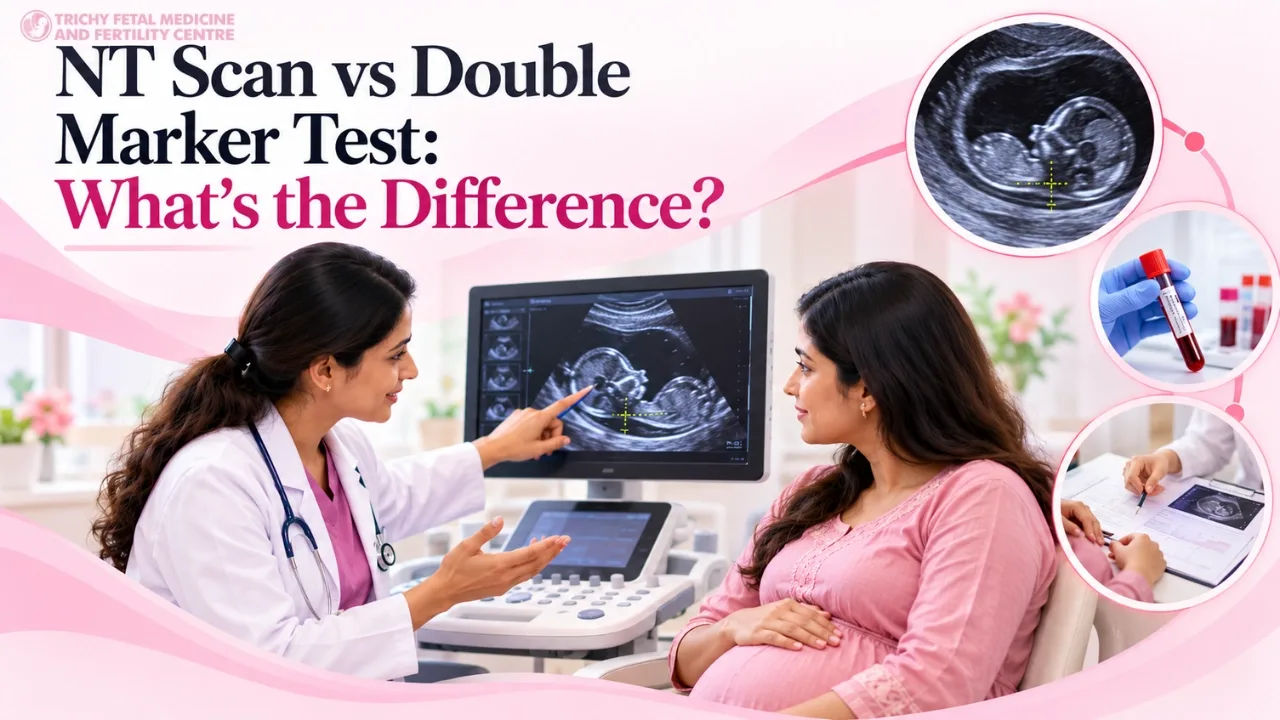
If you are around ten or eleven weeks pregnant, your doctor may have asked for an NT scan and a double marker test in the same breath. The two are usually booked together, which is why many women assume they are one test with two names. They are separate. The NT scan is an ultrasound of your baby, and the double marker is a blood test taken from you.
NT stands for nuchal translucency. In early pregnancy there is normally a small pocket of fluid under the skin at the back of the baby's neck, and the scan measures its thickness. The best window is 11 weeks to 13 weeks + 6 days, when the baby's crown-rump length is roughly 45 to 84 mm. Outside that range, the measurement cannot be judged reliably.
The same appointment also confirms your due date and the number of babies, and gives a first look at early anatomy.
This is a simple blood draw. The lab measures two things, free beta-hCG, a hormone made in early pregnancy, and PAPP-A, a protein produced by the placenta. Hence the name "double".
Most women have the sample taken close to the NT scan. Your values are then compared with what is typical for your stage of pregnancy, so the lab needs to know your dates accurately.
| NT scan | Double marker test | |
|---|---|---|
| Type of test | Ultrasound | Blood test |
| What it measures | Fluid space behind the neck | Free beta-hCG and PAPP-A |
| Typical timing | 11 weeks to 13 weeks + 6 days | Late first trimester |
| Other information | Dating, number of babies, early anatomy | Placental hormone and protein levels |
: Type of test
NT scan: Ultrasound
Double marker test: Blood test
: What it measures
NT scan: Fluid space behind the neck
Double marker test: Free beta-hCG and PAPP-A
: Typical timing
NT scan: 11 weeks to 13 weeks + 6 days
Double marker test: Late first trimester
: Other information
NT scan: Dating, number of babies, early anatomy
Double marker test: Placental hormone and protein levels
NT scan vs double marker test at a glance
Because each one answers a different question. The scan shows how the baby looks. The blood test hints at how the placenta is working.
Software then blends the NT measurement, the blood values and your age into one number, usually written as a ratio such as 1 in 1000. You may see this called combined first-trimester screening. Some clinics do it all in a single visit, which is the idea behind OSCAR. Used this way, the result is generally more informative than either test on its own.
Your report will usually say low risk or high risk. Low risk means the estimated chance of Down syndrome, trisomy 18 or trisomy 13 sits below the lab's cut-off. High risk means it sits above. Where that line falls depends on the lab and software used.
Neither label settles the question. Many women with a high-risk result go on to have a healthy baby, and a low-risk result cannot rule out every condition. When the result is high-risk, doctors often talk through genetic counselling, NIPT, or a diagnostic procedure such as CVS or amniocentesis.
One detail often gets missed. A low PAPP-A value can sometimes lead your doctor to plan extra growth scans later on, even when the chromosome risk is low.
NIPT looks at fragments of fetal DNA in the mother's blood. It is a different blood test from the double marker, not a replacement name for it. Whether it makes sense for you depends on your history, your scan and your doctor's advice.
If your result is high-risk, your NT measurement is increased or the report simply does not make sense to you, a fetal medicine consultation can help. Patients in Trichy can reach Trichy Fetal Medicine and Fertility Centre through the official website to discuss first-trimester screening.
A screening report can look final when it is really the start of a conversation. Take it to your obstetrician or fetal medicine specialist, and ask them what the numbers mean for your pregnancy.
If your doctor has suggested this, our Down's screening (OSCAR) page lists what is included and how to book; the team is happy to talk it through first.
This guide is for general information and does not replace a consultation with a fetal medicine specialist.
In line with the PCPNDT Act, we do not perform or support sex determination.
Down's Screening (OSCAR)
A combined first trimester screening that assesses the chance of Down's syndrome and other chromosomal conditions.
Card 1 of 3
Call us, message us on WhatsApp, or send a request and our team will call you back to schedule your visit.
Mon - Fri: 9:00 AM - 9:00 PM