Screening and tests
What Happens After an Abnormal NT Scan?
An abnormal NT scan raises a question and does not give a final answer. Here is how doctors usually work through it, step by step.
Reviewed24 October 20268 min read

NIPT, NT scan and double marker test all screen for chromosomal conditions in early pregnancy. Compare how they work, timing, accuracy and which may suit you.
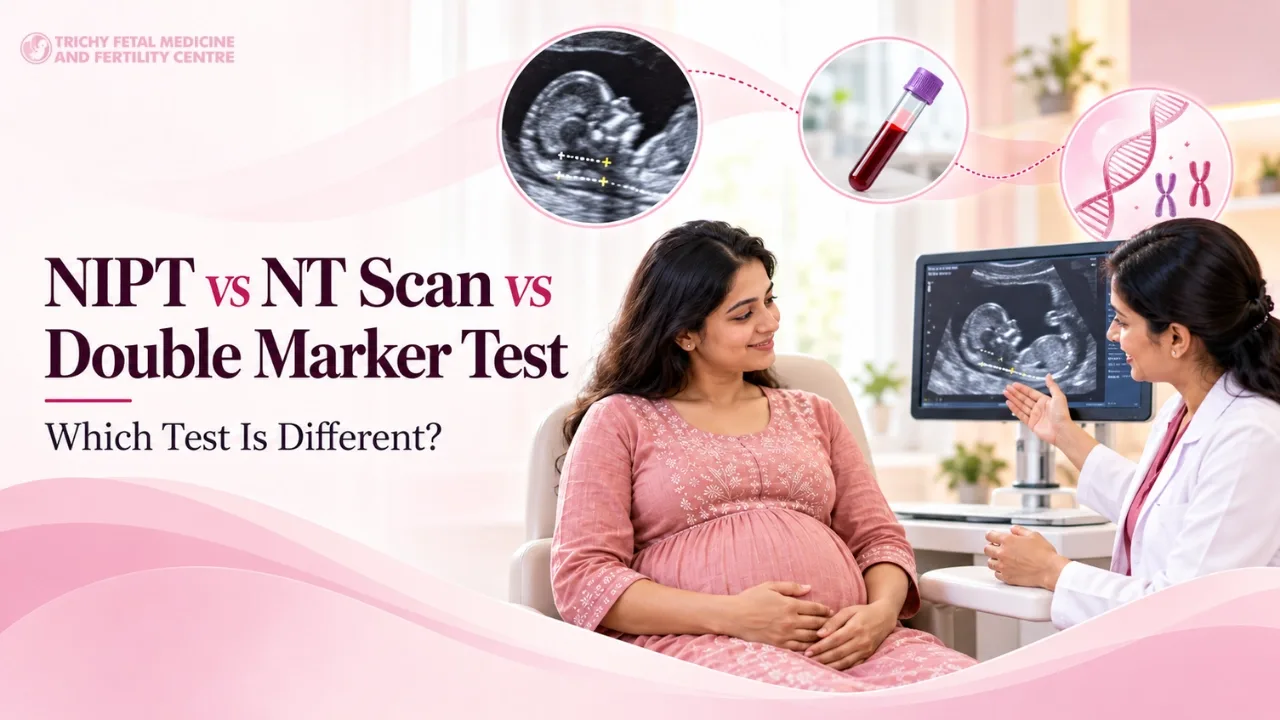
Early pregnancy screening helps estimate the chance that a baby has a chromosomal condition such as Down syndrome. The three tests most often discussed are the NT scan, the double marker blood test and NIPT. They work differently, are done at slightly different times and have different accuracy.
Nuchal translucency (NT) is a small fluid space at the back of the baby's neck. An increased measurement can be associated with chromosomal conditions, heart problems and some other conditions. The scan, done between about 11 and 14 weeks, also checks the baby's heartbeat, dating, number of babies and early anatomy, and may assess the nasal bone and blood flow.
The double marker test measures PAPP-A and free beta hCG in the mother's blood. Results are combined with the NT measurement, maternal age and other factors to calculate a risk score for trisomy 21, 18 and 13. This combined approach detects most, but not all, cases.
Non-invasive prenatal testing analyses cell-free DNA that comes mainly from the placenta and circulates in the mother's blood. It can be done from about 10 weeks. It screens mainly for trisomy 21, 18 and 13, and some panels include other conditions. NIPT has a high detection rate and a lower false-positive rate than combined screening for trisomy 21.
| Feature | NT scan | Double marker | NIPT |
|---|---|---|---|
| Type | Ultrasound | Blood test | Blood test |
| Timing | About 11 to 14 weeks | About 9 to 13 weeks | From about 10 weeks |
| Main purpose | Neck fluid, early anatomy | Hormone markers | Placental DNA analysis |
| Accuracy for Down syndrome | Better when combined | Better when combined | Highest of the three |
| Detects structural problems | Some early ones | No | No |
| Diagnostic? | No | No | No |
NIPT does not examine the baby's structure. The NT scan can detect early anatomical problems, increased NT linked to heart defects and other conditions, and confirm dating and twins. Many specialists recommend an NT scan even when NIPT is done.
A high-risk result from any screening test needs counselling and usually a diagnostic test such as chorionic villus sampling (CVS) or amniocentesis before any decisions are made.
The choice depends on your age, history, previous results, twin pregnancy, cost and personal preferences. Your fetal medicine specialist will explain options. In India, sex determination is prohibited by law, so fetal sex is not disclosed.
Understanding each test helps you choose the screening that suits your pregnancy. Counselling before and after testing is important. Dr Malathi G. Prasad offers first-trimester screening and fetal medicine counselling in Trichy.
To arrange this at our Trichy centre, see NIPT; if you are unsure whether you need it, our doctors can tell you after a review.
This guide is for general information and does not replace a consultation with a fetal medicine specialist.
In line with the PCPNDT Act, we do not perform or support sex determination.
NIPT
A simple blood test from the mother that screens for common chromosomal conditions, with no risk to the baby.
Card 1 of 3
Call us, message us on WhatsApp, or send a request and our team will call you back to schedule your visit.
Mon - Fri: 9:00 AM - 9:00 PM