Screening and tests
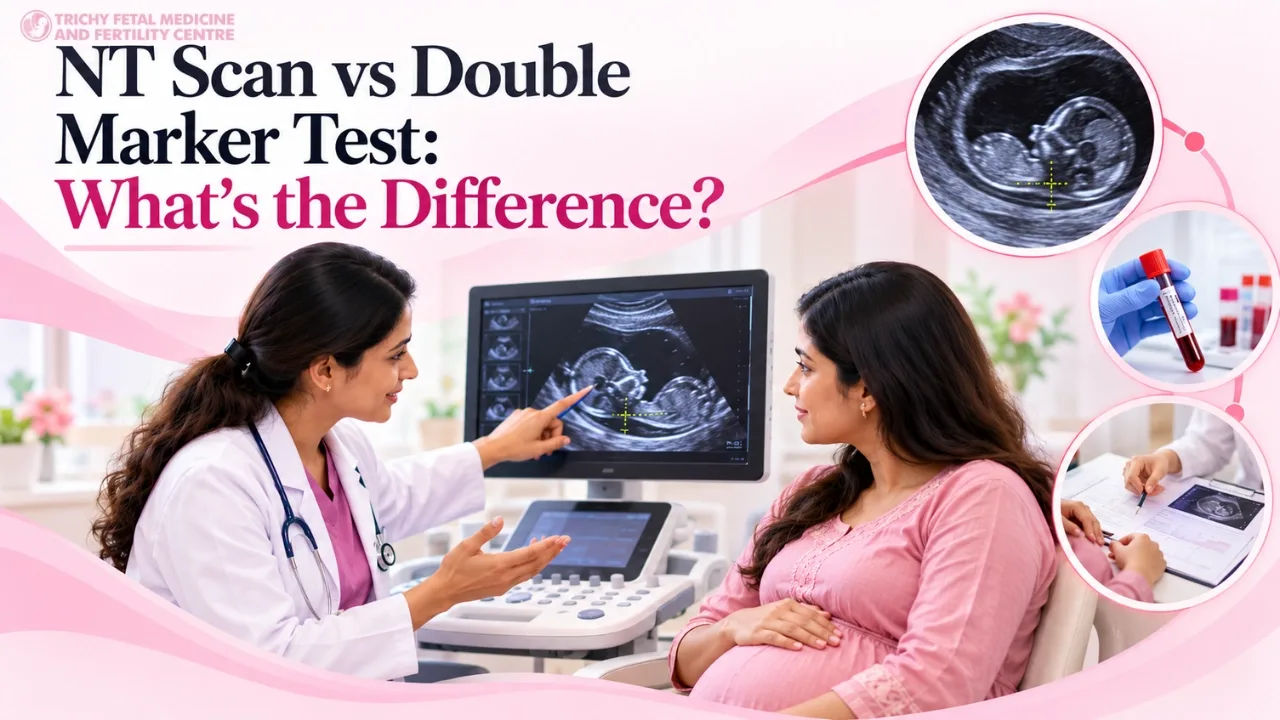
NT Scan vs Double Marker Test: What's the Difference?
The NT scan is an ultrasound and the double marker is a blood test. Learn how doctors read the two together in first-trimester screening.
Reviewed23 October 20266 min read
An abnormal NT scan raises a question and does not give a final answer. Here is how doctors usually work through it, step by step.

Most people hear the words "your NT is increased" while still lying on the couch with gel on their tummy, and very little of what follows registers. If that was you, here is the plan most doctors follow from that point. The NT, or nuchal translucency, is the thin pocket of fluid behind your baby's neck, measured at the 11 to 14 week scan. When it comes out larger than expected for your baby's size, the result is called abnormal. It tells your doctor where to look next, and it does not tell you what is wrong.
The NT figure only makes sense next to the baby's crown-rump length, which is the head-to-bottom measurement taken at the same scan. Many centres call an NT increased when it reaches about 3.5 mm, or sits above the 95th centile for that crown-rump length, though protocols differ a little between units.
A thicker NT goes with a higher chance of chromosomal conditions such as Down syndrome, and also with certain heart differences and genetic syndromes. That shifts the odds without deciding the outcome, and a good number of pregnancies with an increased NT end with normal results and a healthy baby.
Your doctor will begin by checking the scan itself: whether the baby was in a suitable position for the measurement, and whether your dates are right. A week's error in dating is enough to change how the number is read.
After that you should be offered a proper conversation with a fetal medicine specialist or genetic counsellor. They will explain your risk, go through the options and leave the decision with you. It helps to bring your scan report and blood test results, and to write your questions down beforehand, since appointments like this tend to go by quickly.
If you had the first-trimester blood tests, their results are folded into the NT to give a risk estimate that is specific to you rather than a general one.
NIPT reads fragments of your baby's DNA found in your blood. It is a screening test, so the answer it gives is still a probability. When the NT is markedly raised or a structural finding has been seen, many specialists would rather go straight to a diagnostic test, since NIPT mostly looks for the common trisomies and can miss other causes.
These two tests can confirm whether a chromosome condition is present. CVS takes a tiny sample of placental tissue, usually between 11 and 14 weeks. Amniocentesis draws off a small amount of the fluid around the baby, usually from about 15 weeks. In both cases a thin needle is guided by ultrasound.
Either procedure carries a small risk of miscarriage, and your specialist should tell you what that means in your case rather than quoting a general figure. The lab often gives a rapid result for the common trisomies first, followed by a finer analysis such as chromosomal microarray, which can pick up smaller chromosome changes.
A thick NT can sometimes go along with a heart or other structural difference even when the chromosomes are normal, which is why a detailed anomaly scan at around 18 to 22 weeks is almost always advised. A fetal echocardiogram looks at the heart in particular. Some centres can offer an earlier detailed scan at the end of the first trimester.
You can take real comfort from it, though your doctor may still want to keep watching. Some genetic syndromes are missed by standard chromosome tests, and certain structural conditions only become visible as the baby grows. Repeat scans are common, and further genetic testing is occasionally suggested.
If every scan stays normal, the outlook is generally good. Nobody can promise a healthy baby, which is exactly why the follow-up plan exists.
Sooner is better, because the timing of the pregnancy decides which tests are still possible. If you live in Trichy or elsewhere in Tamil Nadu, you can contact Trichy Fetal Medicine and Fertility Centre through the official website for a fetal medicine consultation, genetic counselling and diagnostic procedures such as CVS and amniocentesis.
An abnormal NT result can turn a happy pregnancy into a few anxious weeks, and that reaction is entirely understandable. The steps ahead are manageable, and each one brings a little more clarity. Talk the findings through with your obstetrician or a fetal medicine specialist, ask whatever is on your mind, and take the time you need to decide what is right for your family.
If this applies to your pregnancy, our genetic counselling page explains what the visit involves, or you can meet our specialists before you decide anything.
This guide is for general information and does not replace a consultation with a fetal medicine specialist.
In line with the PCPNDT Act, we do not perform or support sex determination.
Genetic Counselling
In-house counselling that explains results, inheritance, and your options in clear language.
Card 1 of 3
Call us, message us on WhatsApp, or send a request and our team will call you back to schedule your visit.
Mon - Fri: 9:00 AM - 9:00 PM