Screening and tests
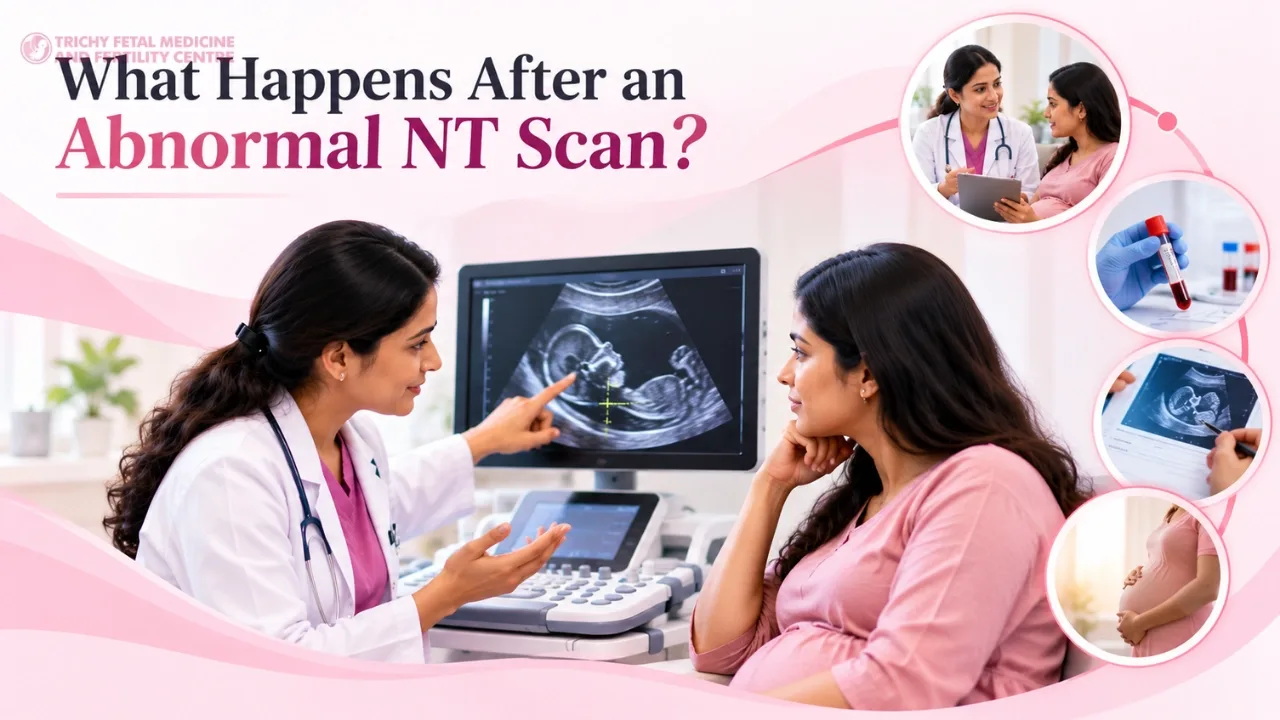
What Happens After an Abnormal NT Scan?
An abnormal NT scan raises a question and does not give a final answer. Here is how doctors usually work through it, step by step.
Reviewed24 October 20268 min read
A high NT measurement means extra fluid behind the baby's neck on the first-trimester scan. Learn what it may indicate and what usually happens next.
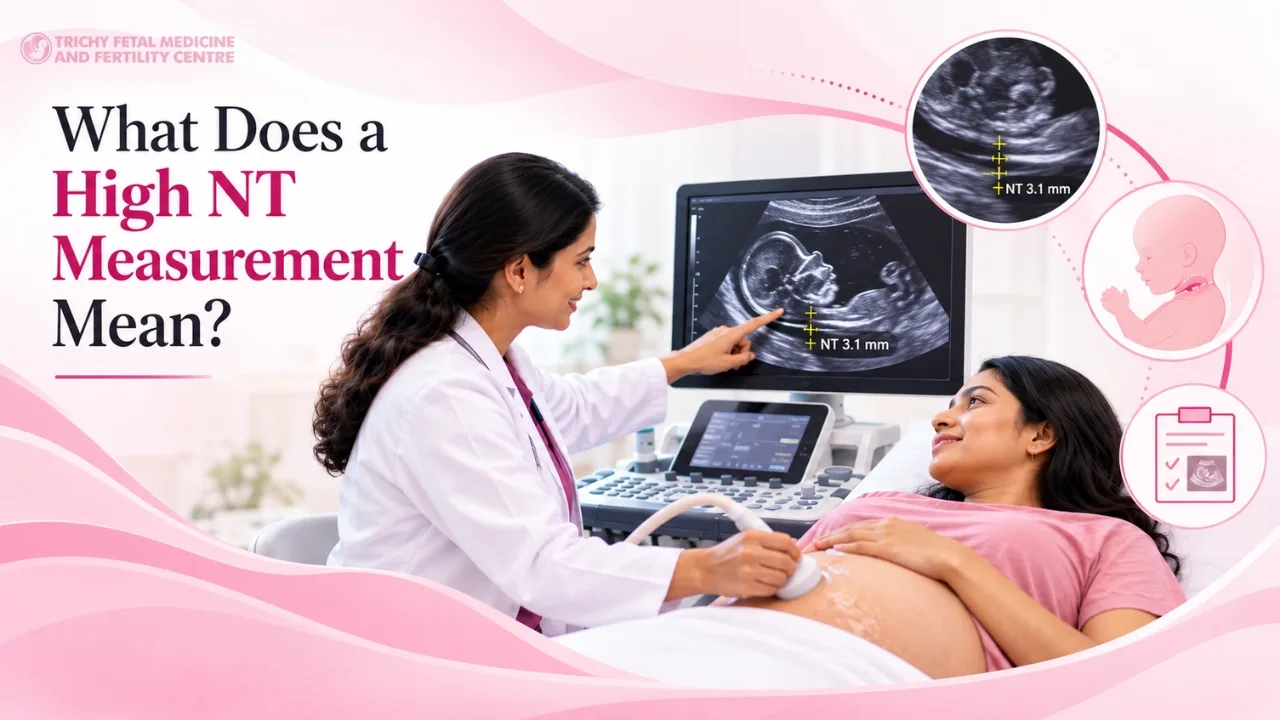
If your first-trimester scan report says the NT is high, the first thing to know is that this is not a diagnosis. NT stands for nuchal translucency, the thin layer of fluid under the skin at the back of the baby's neck. When that layer measures more than expected for the baby's size, doctors take it as a cue to look further. Many babies in this situation are healthy, and this article explains what the result can point to and what usually happens next.
There is no single number that applies to every pregnancy. Many centres treat 3.5 mm or above as increased. Others compare the reading with what is expected for the baby's crown-rump length and flag anything above the 95th centile.
Technique matters too. Baby's position, image quality and the operator's training all affect the figure, which is why NT should be measured by a certified sonographer or doctor and read alongside your blood tests and age. Timing of the scan is covered in our main NT scan guide.
Sometimes the cause is a chromosomal condition such as Down syndrome, trisomy 18, trisomy 13 or Turner syndrome. Sometimes it is a difference in the baby's heart, since early cardiac development can influence how fluid collects in the neck. Rarer genetic syndromes are also on the list.
Often, though, nothing is found. The larger the measurement, the more likely an underlying cause becomes, and a mildly raised NT is more often followed by a normal outcome.
No. NT is combined with the blood markers and your age to produce a risk estimate, and an estimate is not a diagnosis. Plenty of women with a high-risk result deliver babies without any chromosomal condition. Only a diagnostic test can answer the question for certain.
The plan depends on the measurement and on what you want to know. A typical sequence looks like this.
You will usually start with genetic counselling. The specialist explains the result in plain terms, along with what each possible test can and cannot show.
NIPT, a blood test that screens for the common chromosomal conditions, may be offered next. It is more accurate than NT alone but remains a screening test, so when the NT is markedly raised many doctors move directly to a diagnostic procedure.
Those procedures are chorionic villus sampling (CVS), possible from about 11 weeks, and amniocentesis, from about 15 weeks. Both examine the baby's chromosomes, and a microarray can detect smaller genetic changes. Each carries a small risk of miscarriage, which your doctor will discuss before you decide.
Around the second trimester, a detailed anomaly scan and a fetal echocardiogram check the baby's structure and heart. A raised NT is a recognised reason to examine the heart closely.
In some pregnancies the fluid settles by itself, so a repeat scan may also be planned.
The choices are yours. Good counselling presents them neutrally, and asking early gives you more options on timing.
If the genetic results, anomaly scan and fetal echo are reassuring, the outlook is generally good despite the early finding. Some doctors still suggest a growth scan later in pregnancy. No set of tests rules out everything, so it is worth asking exactly what has been excluded.
Ideally soon after the result, while every testing option is still open. Patients seeking fetal medicine consultation in Trichy can contact Trichy Fetal Medicine and Fertility Centre through the official website.
Waiting for answers after a high NT is the hardest part for most parents. Knowing what each test can tell you, and having a specialist to guide you through it, makes that wait easier to bear.
When you are ready, the Down's screening (OSCAR) service page covers timings and preparation; questions about your own situation are best put to our specialists.
This guide is for general information and does not replace a consultation with a fetal medicine specialist.
In line with the PCPNDT Act, we do not perform or support sex determination.
Down's Screening (OSCAR)
A combined first trimester screening that assesses the chance of Down's syndrome and other chromosomal conditions.
Card 1 of 3
Call us, message us on WhatsApp, or send a request and our team will call you back to schedule your visit.
Mon - Fri: 9:00 AM - 9:00 PM