Screening and tests
What Happens After an Abnormal NT Scan?
An abnormal NT scan raises a question and does not give a final answer. Here is how doctors usually work through it, step by step.
Reviewed24 October 20268 min read
An NT scan can estimate the chance of Down syndrome but cannot diagnose it. Learn what the result means and which tests can give a definite answer.
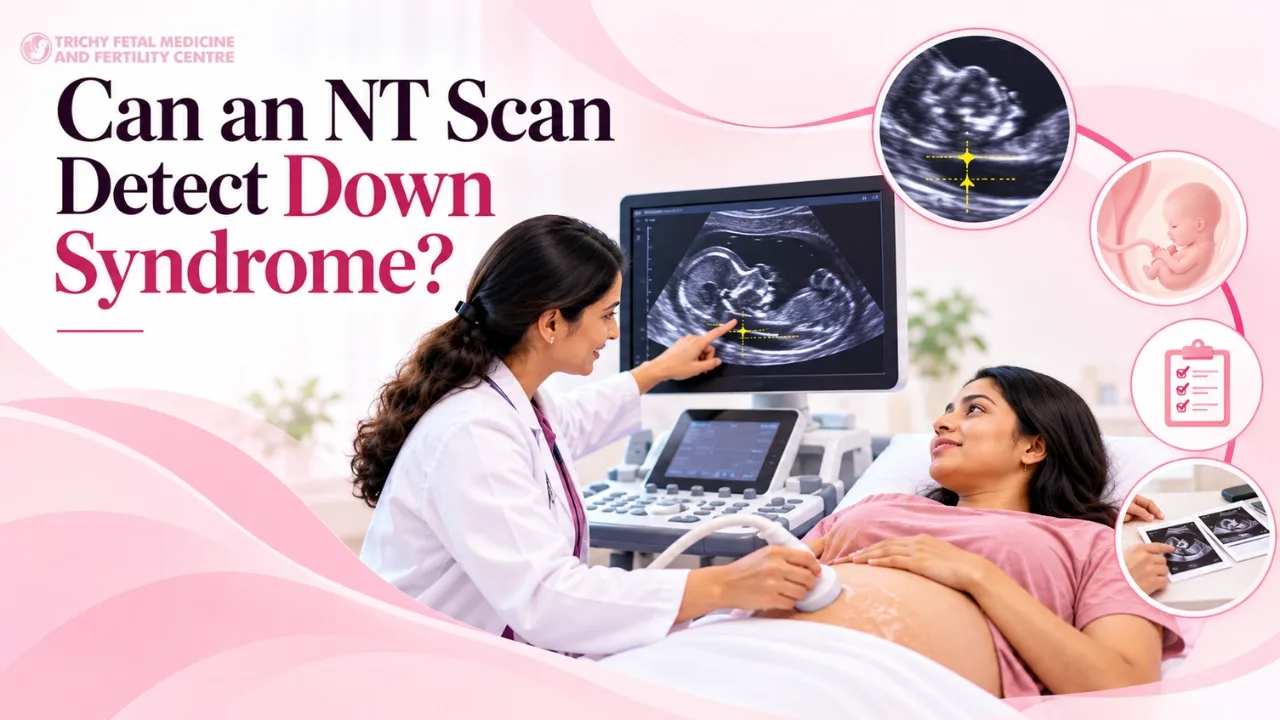
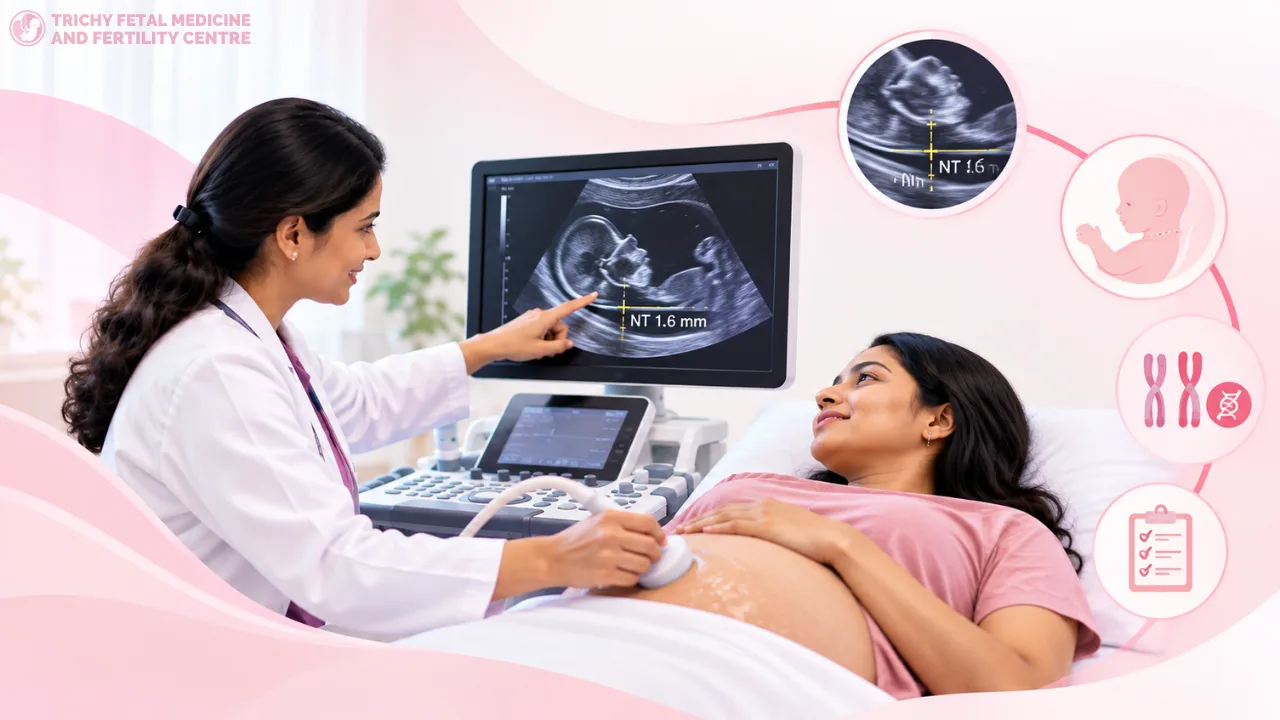
Not in the way most parents hope. An NT scan can show that a baby has a higher or lower chance of Down syndrome, but it cannot confirm the condition or rule it out. The scan measures a small pocket of fluid at the back of the baby's neck in the first trimester, and doctors use that measurement to estimate risk. Many of the worries that follow an NT report come from treating an estimate as an answer.
Down syndrome occurs when a baby has an extra copy of chromosome 21. In some affected pregnancies, more fluid than usual collects behind the neck during the first trimester, and an ultrasound can measure it.
The connection is a pattern across many pregnancies, not a rule for any single one. Plenty of babies with a larger NT turn out to be unaffected, and some babies with Down syndrome have a perfectly typical measurement.
NT on its own has limits, so it is rarely used alone. In first-trimester combined screening, the NT measurement is read together with the mother's age, the baby's crown-rump length and two blood markers, free beta-hCG and PAPP-A. A software calculation then produces one overall risk figure.
Combined screening is commonly quoted as identifying most Down syndrome pregnancies, roughly 85 to 90 percent, with about 5 percent of women getting a false-positive result. Those numbers differ between studies and screening programmes, so ask your doctor how the test performs where you are being screened. Either way, a few affected pregnancies will be missed, and many high-risk results will prove to be false alarms.
Most reports give a ratio such as 1 in 1,000 or 1 in 50. The bigger the second number, the lower the estimated chance.
A lower-risk result is reassuring, though low is not the same as none. A higher-risk result means the chance has crossed the cut-off used by the laboratory or clinic. That is a signal to talk through the options, and it says nothing yet about whether the baby is affected.
The figure is only as good as the scan behind it. Operator training, fetal position and an accurate crown-rump length all influence how much weight the number can carry.
You need a test that looks at the baby's chromosomes directly.
CVS takes a tiny sample of placental tissue, usually between the end of the first trimester and early in the second. Amniocentesis collects a small amount of amniotic fluid, typically from about 15 weeks. Both are guided by ultrasound and carry a small risk of miscarriage, which your doctor should explain before you decide.
NIPT sits between screening and diagnosis. This blood test analyses fragments of the baby's DNA in the mother's blood and is generally more accurate than combined screening for Down syndrome. It is still a screening test, though, so a high-risk NIPT result normally calls for CVS or amniocentesis to confirm it.
Take the whole report to your obstetrician or a fetal medicine specialist, not just the NT figure. Ask what your overall risk is, whether anything else was seen on the scan, and whether NIPT or diagnostic testing would tell you something useful in your situation.
Genetic counselling can help you work through the choices. Some couples want certainty early, others prefer to wait, and either is a reasonable decision to make with proper information.
An NT scan gives early information, but it was never designed to deliver a verdict. If your result is lower risk, you have a reassuring estimate. If it is higher, you have good reason to ask more questions and, if you wish, to look at testing that can give a clearer answer.
Patients in Trichy seeking fetal medicine consultation can contact Trichy Fetal Medicine and Fertility Centre through the official website.
For appointments, the Down's screening (OSCAR) page has the details, and our fetal medicine specialists can advise whether it fits your situation.
This guide is for general information and does not replace a consultation with a fetal medicine specialist.
In line with the PCPNDT Act, we do not perform or support sex determination.
Down's Screening (OSCAR)
A combined first trimester screening that assesses the chance of Down's syndrome and other chromosomal conditions.
Card 1 of 3
Call us, message us on WhatsApp, or send a request and our team will call you back to schedule your visit.
Mon - Fri: 9:00 AM - 9:00 PM