If pregnancy has not happened despite trying, the next step is not always another pregnancy test or another month of waiting. A fertility evaluation can help identify factors that may be making conception difficult.
Fertility involves both partners. In a woman, doctors may look at ovulation, ovarian reserve, the uterus and fallopian tubes. In a man, the first investigations often focus on sperm and semen. Sometimes one factor is identified; sometimes several factors contribute; and in some couples, routine testing does not reveal an obvious explanation.
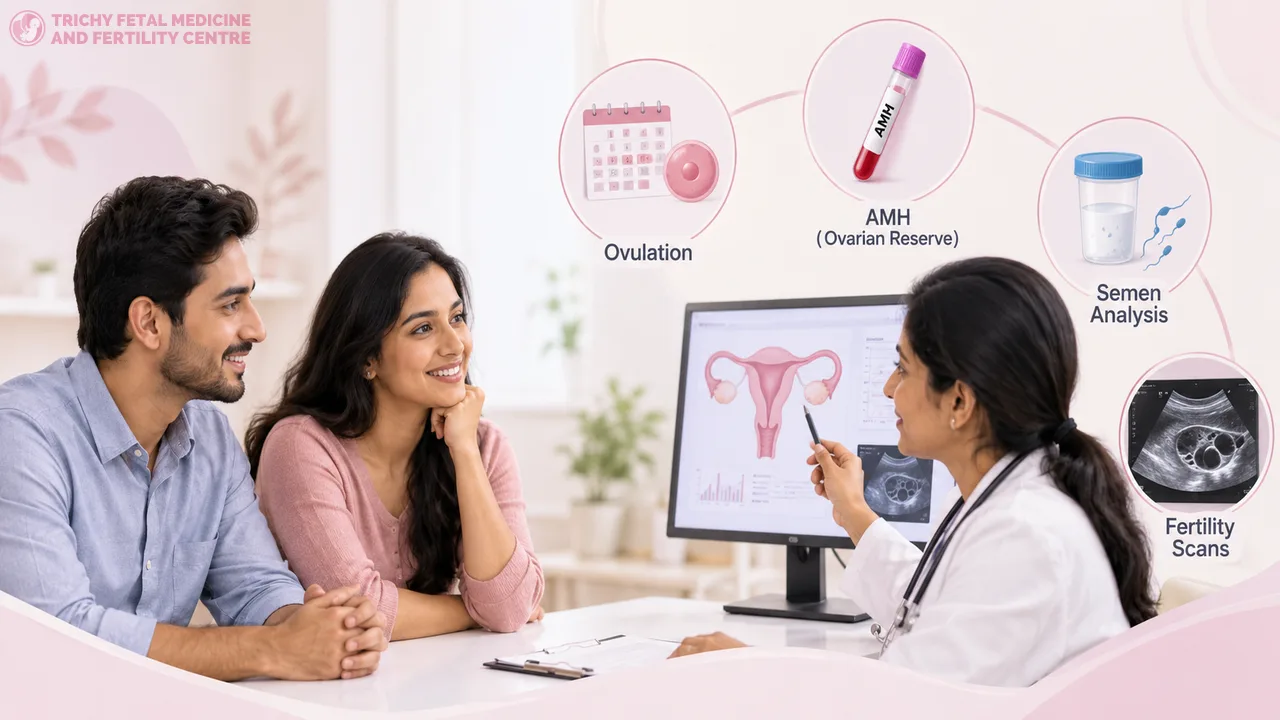
This guide explains the main fertility tests, including AMH, ovulation assessment, semen analysis, ultrasound and follicular monitoring, and what these tests can, and cannot, tell you.
When should a couple consider fertility testing?
The timing depends partly on the woman's age and whether there are reasons to suspect a fertility problem.
For couples who are trying naturally, an evaluation is commonly considered after:
12 months of regular, unprotected intercourse when the woman is under 35
6 months when the woman is 35 or older
A shorter period, or sometimes immediate evaluation, when there is a known or suspected fertility problem
There are situations where waiting for six or twelve months may not make sense. Very irregular or absent periods, previous pelvic surgery, suspected endometriosis, known tubal problems or concerns about sperm may justify an earlier consultation.
Age is also relevant because female fertility changes with increasing age.
The right time to seek an evaluation is therefore not determined by the calendar alone. A doctor's assessment of the couple's circumstances matters.
Why are both partners usually evaluated?
It is easy for fertility testing to become focused almost entirely on the woman. Medically, that is not always appropriate.
Difficulty conceiving can be related to female factors, male factors, a combination of factors or, in some cases, no clearly identifiable cause.
When a male partner is contributing sperm, his evaluation can often begin with a medical and reproductive history and a semen analysis. At the same time, the woman may be assessed for ovulation, ovarian reserve, tubal factors or problems involving the uterus.
Looking at both sides early can give the doctor a more complete picture and may prevent unnecessary delays.
What does a fertility evaluation for a woman involve?
There is no universal checklist that every woman needs.
A fertility specialist usually starts with the basics: age, menstrual cycles, previous pregnancies, medical history and how long the couple has been trying. Those details help determine which investigations are actually useful.
Depending on the situation, assessment may include:
Ovulation assessment
Ovarian-reserve testing
Pelvic or transvaginal ultrasound
Follicular monitoring
Assessment of the fallopian tubes
Assessment of the uterus
Selected blood tests
Someone with regular cycles and no concerning history may need a different evaluation from someone with irregular periods, previous pelvic surgery or suspected endometriosis.
How is ovulation assessed?
Ovulation is the release of an egg from an ovary. Because conception generally depends on ovulation occurring, finding out whether and when ovulation takes place can be an important part of fertility assessment.
Doctors can use several approaches.
These include:
Reviewing the menstrual cycle
Urine LH testing
Blood progesterone testing in selected circumstances
Ultrasound
Follicular monitoring
Regular periods are useful information, but they do not answer every question about ovulation. If cycles are unpredictable or absent, the doctor may investigate why before deciding which ovulation test is appropriate.
Can you have periods without normal ovulation?
Menstrual bleeding does not always prove that ovulation has occurred.
Some women have relatively regular bleeding but still have ovulatory problems. Others have long or unpredictable cycles because ovulation is occurring irregularly.
Conditions such as PCOS, thyroid disorders, major changes in body weight and certain other medical or hormonal problems can affect ovulation.
This is why a fertility consultation looks beyond the date of the last menstrual period. The pattern of the cycles, symptoms and medical history all provide useful clues.
What is an ovulation predictor kit?
Ovulation predictor kits are urine tests that detect a rise in luteinizing hormone, commonly called LH.
The LH surge usually occurs shortly before ovulation. For couples trying to conceive, detecting this rise can help identify the fertile part of the cycle.
There are limitations, though. An LH surge does not directly show that an egg has been released, and interpreting these tests can be more complicated in some women, including some women with PCOS.
If a doctor needs to see what the follicle is actually doing, ultrasound-based monitoring may provide more information.
What is follicular monitoring?
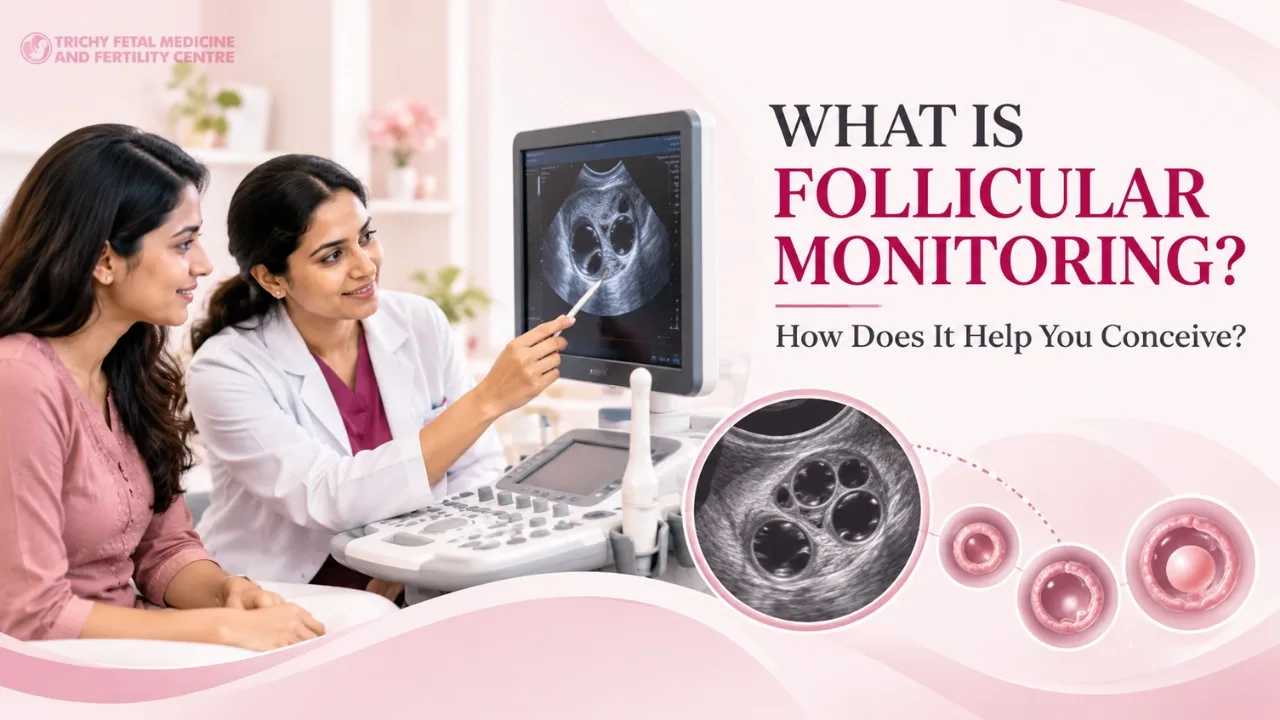
Follicular monitoring uses ultrasound examinations to follow the development of ovarian follicles during a menstrual cycle.
A follicle is a small fluid-filled structure in the ovary that contains a developing egg. During an ovulatory cycle, one follicle generally becomes dominant and grows before ovulation.
By following the follicle over time, the doctor can assess its development and the changes occurring around ovulation.
Depending on why it has been recommended, follicular monitoring may also provide information about:
Follicle growth
Development of a dominant follicle
Approximate timing of ovulation
The endometrial lining
Response to fertility treatment
Unlike a single pelvic ultrasound, follicular monitoring involves observing changes across the cycle.
What is AMH?
AMH stands for anti-Müllerian hormone.
The hormone is produced by cells associated with developing ovarian follicles. An AMH blood test is commonly used as one way of assessing ovarian reserve, broadly, the remaining follicular pool in the ovaries.
This makes AMH useful in certain fertility evaluations, particularly when a doctor needs information about expected ovarian response during fertility treatment.
But AMH is often given more meaning than it deserves.
It is not a complete fertility test. A person's AMH level does not, by itself, tell a doctor whether she will become pregnant naturally.
Does AMH measure egg quality?
No.
AMH is mainly associated with ovarian reserve rather than directly measuring the quality of an individual's eggs.
This distinction is particularly important when reading fertility information online. It is tempting to treat an AMH result as a simple fertility score, but reproductive potential is more complicated than that.
Age, ovulation, sperm factors, the fallopian tubes, the uterus and other health factors can all matter.
AMH is therefore best understood as one piece of the fertility assessment rather than a final answer.
Does a low AMH mean infertility?
A low AMH does not automatically mean that pregnancy is impossible.
It may indicate a lower ovarian reserve and can provide useful information when fertility treatment is being considered. It may also help doctors understand how the ovaries might respond to stimulation.
But a low result does not mean that natural conception cannot occur.
The interpretation depends on the woman's age, menstrual history, ultrasound findings and the reason the test was ordered. The number on the laboratory report should not be considered in isolation.
Can AMH be normal and pregnancy still be difficult?
Yes.
A normal AMH does not rule out every cause of infertility.
For example, the fallopian tubes may be blocked, ovulation may be abnormal, endometriosis may be present, or there may be a male-factor issue. These problems are not ruled out simply because an AMH result falls within the laboratory's reference range.
AMH tells you something about ovarian reserve. It does not assess every part of the reproductive system.
What is antral follicle count?
Antral follicle count, or AFC, is an ultrasound assessment of the small follicles visible in the ovaries.
It is usually performed using transvaginal ultrasound and is often assessed early in the menstrual cycle.
AFC and AMH both provide information related to ovarian reserve, although they measure different things.
A fertility specialist may consider the AFC alongside AMH, age and the rest of the clinical history rather than relying on either measurement alone.
What is a fertility scan?
"Fertility scan" is a broad term. The exact ultrasound examination depends on what the doctor is trying to assess.
A pelvic or transvaginal ultrasound can provide information about the uterus, endometrial lining and ovaries. It can also identify certain structural findings and provide an assessment of ovarian follicles.
If ovulation needs to be followed, the doctor may recommend follicular monitoring, which involves more than one scan.
Ultrasound is useful, but it cannot answer every fertility question. For example, a separate test may be needed when the doctor wants to know whether the fallopian tubes are open.
How are the fallopian tubes checked?
The fallopian tubes are important because they provide the route through which sperm and egg meet and through which the early embryo travels toward the uterus.
If tubal blockage is suspected, the doctor may recommend a test of tubal patency.
One established investigation is hysterosalpingography, commonly called HSG. It uses contrast material and X-ray imaging to examine the uterine cavity and whether the contrast passes through the fallopian tubes.
In selected circumstances, an ultrasound-based contrast study may also be used.
The choice depends on the woman's history, previous investigations and the clinician's assessment.
What fertility tests are done for men?
For men, fertility assessment commonly starts with a medical and reproductive history and a semen analysis.
The semen analysis looks at several characteristics rather than producing one simple fertility score.
Depending on the laboratory method, the report may include:
Semen volume
Sperm concentration
Sperm motility
Sperm morphology
These measurements provide information about sperm production and function.
If the result is abnormal, the next step depends on what is abnormal and the man's wider medical history. Further assessment or repeat testing may be appropriate.
What does a semen analysis actually tell you?
Semen analysis is one of the main initial tests used to investigate possible male-factor fertility problems.
It examines the semen sample and measures characteristics of the sperm within it.
A result outside the laboratory's reference range does not automatically mean that a man cannot father a child. Sperm parameters can vary, and the report needs to be considered in context.
Likewise, a result that looks reassuring does not guarantee pregnancy.
The test provides information about one part of reproduction; it does not measure the couple's overall chance of conception.
What happens if the semen analysis is abnormal?
An abnormal semen analysis is a reason for further discussion, not a conclusion that pregnancy is impossible.
Depending on the findings, a doctor may recommend repeating the test or arranging additional evaluation.
The reason matters. Different abnormalities can point toward different possible causes, and some men may need assessment of hormonal, reproductive or general medical factors.
A specialist may also review medications, previous infections, surgery and other factors that could affect sperm production or function.
Which blood tests may be used in fertility assessment?
Blood tests are chosen according to the clinical question.
For women, testing may include investigations related to ovarian reserve, ovulation, thyroid function or other reproductive hormones when indicated.
AMH is one example. Progesterone may be useful in selected situations when the doctor is assessing whether ovulation has occurred.
There is no need for every patient to have every reproductive hormone measured. The menstrual pattern and medical history help determine which tests are likely to add useful information.
Does every woman trying to conceive need an AMH test?
No.
AMH can be useful, but it is not a universal test of whether someone can become pregnant.
It is particularly relevant when a clinician is assessing ovarian reserve or planning assisted fertility treatment. It should not be used on its own to predict spontaneous pregnancy.
A fertility evaluation is more useful when each test has a clear purpose.
What if all the fertility tests are normal?
Normal test results do not always explain why pregnancy has not occurred.
Some couples have a normal initial evaluation but still experience difficulty conceiving. This may be described as unexplained infertility when no specific cause is identified after appropriate assessment.
That does not mean the symptoms or concern are not real. It means that the available investigations have not identified a clear explanation.
The next step depends on the couple's age, duration of trying, previous history and the results already obtained.
What factors can affect fertility?
Fertility is influenced by several parts of the reproductive system, and these factors can overlap.
They include:
Age
Ovulation
Ovarian reserve
Sperm production and function
Fallopian tube patency
Uterine structure
Endometriosis
Certain hormonal or metabolic conditions
Previous pelvic infections or surgery
Other medical or reproductive factors
This is why fertility evaluation works better as a complete assessment than as a search for one abnormal laboratory value.
What happens during the first fertility consultation?
The first consultation often starts with questions rather than scans or blood tests.
The doctor may want to know:
How old each partner is
How long you have been trying
Whether intercourse is regular
Whether menstrual cycles are regular
Whether either partner has had previous pregnancies
Whether there have been miscarriages or an ectopic pregnancy
Whether there has been pelvic or reproductive surgery
Whether either partner has a significant medical condition
Which medicines are being taken
Whether previous fertility treatment has been attempted
The male partner's history is relevant too.
Once the doctor understands the background, the investigation can be tailored to the couple rather than following a fixed package of tests.
Do couples need every fertility test available?
No.
A longer list of investigations is not automatically a better fertility evaluation.
Some tests are useful only when there is a particular reason to order them. Others may become relevant if an initial investigation produces an unexpected finding.
Depending on the circumstances, a doctor may consider additional hormone testing, advanced sperm investigations, genetic testing or other procedures.
The goal is to answer the clinical questions that matter for that couple, step by step.
Can fertility testing be done before trying to conceive?
In some situations, yes.
A complete fertility work-up is not routinely necessary for every couple before they begin trying.
However, a preconception consultation can be useful when there is already a concern about reproductive health. Examples include very irregular periods, previous pelvic surgery, a known reproductive condition or a medical history that could affect fertility.
The value of testing before trying depends on the reason for the consultation. A doctor can help determine whether investigation is actually warranted.
When should you see a fertility specialist?
Consider discussing fertility evaluation if pregnancy has not occurred within the expected timeframe for your age.
An earlier consultation may make sense if you have:
Very irregular or absent periods
Suspected problems with ovulation
Known PCOS or another condition affecting reproductive hormones
The purpose of an early consultation is not necessarily to begin treatment. It can simply help clarify whether testing is needed and, if so, where to start.
Fertility testing for couples in Trichy
For couples in Trichy or Tiruchirappalli seeking fertility evaluation, the first step is usually understanding the couple's individual history rather than choosing tests from a standard list.
Trichy Fetal Medicine and Fertility Centre includes fertility and reproductive health within its areas of care. Its planned fertility content cluster specifically covers fertility testing for women and men, AMH, ovulation, semen analysis and follicular monitoring.
A fertility consultation can help determine which investigations are relevant and how the results should be interpreted together.
Fertility testing is not about finding one number that says whether a couple can or cannot have a baby.
AMH tells doctors something about ovarian reserve. Semen analysis provides information about sperm. Ultrasound can show the ovaries and uterus, while follicular monitoring can help assess what happens during an individual cycle. Other investigations answer different questions.
The useful part is how these pieces fit together.
If you have been trying to conceive and are unsure whether you need testing, a fertility consultation can help you understand which investigations are appropriate for your circumstances and what the results actually mean.
If you want a specialist opinion on your own situation, the team is a call or a visit away.