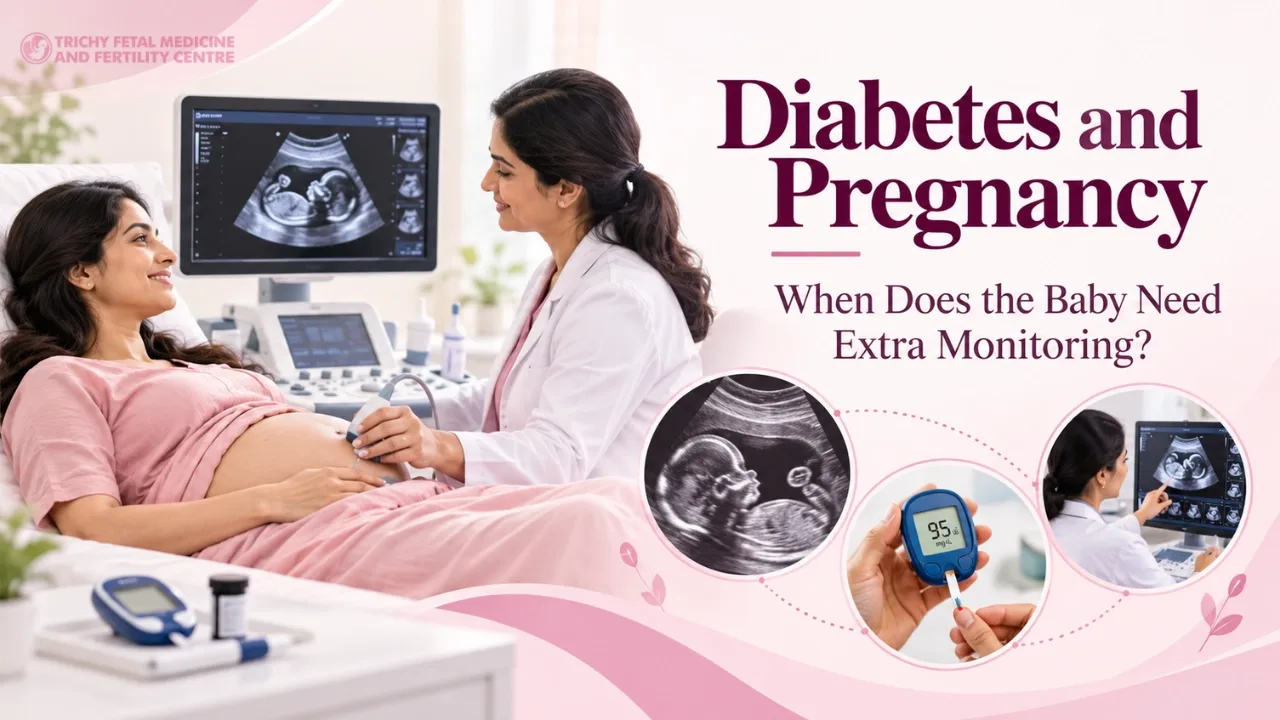
Diabetes and Pregnancy: When Baby Needs Extra Monitoring
Diabetes in pregnancy can affect your baby's growth, heart and fluid levels. Learn which scans and checks are used, when they are done and why they matter.
Diabetes in pregnancy is common, and most women with good care have healthy babies. Still, high blood sugar can affect how a baby grows and develops, so doctors add extra scans and checks. Knowing what to expect can ease worry and help you take part in your care.
Which types of diabetes need extra monitoring?
Pre-existing diabetes: Type 1 or type 2 diabetes before pregnancy.
Gestational diabetes: Diabetes first found in pregnancy. Monitoring depends on how well it is controlled and whether insulin is needed.
The higher the sugars, especially in early pregnancy, the more monitoring is advised.
How can diabetes affect the baby?
Birth defects: High sugar in the first weeks can raise the risk of heart, spine, kidney and other defects.
Excess growth (macrosomia): The baby may grow large, raising the risk of difficult delivery and shoulder injury.
Fetal growth restriction: Less often, in women with long-standing diabetes or kidney or blood vessel disease, the baby may grow too slowly.
Too much amniotic fluid (polyhydramnios).
Low sugar in the newborn after birth.
Breathing problems and preterm birth.
Stillbirth, a rare but real risk when sugars are poorly controlled.
What scans and checks are used?
1. Early dating scan
Confirms the due date and checks the baby's heartbeat. Accurate dates are important for planning later checks.
2. Nuchal translucency and first-trimester screening
Often combined with the early scan. It screens for chromosomal conditions and can show signs of heart problems.
3. Detailed anomaly scan (18 to 22 weeks)
A careful look at the baby's brain, spine, face, heart, kidneys and limbs. Women with diabetes often need a thorough scan by a fetal medicine specialist.
4. Fetal echocardiography
A special heart scan, usually at 20 to 24 weeks, advised for women with pre-existing diabetes or poor early sugar control, because the baby's heart is more likely to be affected.
5. Growth scans
Usually from 28 weeks, repeated every 2 to 4 weeks. They estimate the baby's weight and the amount of amniotic fluid. This helps to detect both large and small babies.
6. Doppler studies
Used if the baby is small or if there are blood pressure or kidney problems. Doppler measures blood flow in the umbilical cord and the baby's vessels.
7. Kick counts and cardiotocography (CTG)
You may be asked to count baby movements daily. A CTG records the baby's heart rate and may be done weekly in late pregnancy for those on insulin or with poor control.
How does good sugar control help?
Keeping sugars within target lowers the risk of birth defects, large babies and other complications. Your team may ask you to monitor sugars several times a day, follow a meal plan, walk after meals and take insulin or medicines.
When should delivery be planned?
For well-controlled gestational diabetes, delivery is often planned around 39 to 40 weeks. For pre-existing diabetes or complications, delivery may be offered earlier, often between 37 and 39 weeks. The mode of delivery depends on the baby's size, your health and previous history. Steroid injections for the baby's lungs may be used if early delivery is needed.
What happens after birth?
The baby's blood sugar is checked in the first hours, and feeding is started early. After delivery, insulin needs fall quickly. Women with gestational diabetes need a sugar test at 6 to 12 weeks.
When should you call your doctor?
Reduced baby movements
Blood sugar readings repeatedly above target or episodes of low sugar
Vomiting, severe thirst or ketones
Swelling, headache or vision changes, which may suggest high blood pressure
Leaking fluid or contractions before term
Keeping it simple
With careful monitoring and good sugar control, most women with diabetes have healthy pregnancies. If you have diabetes and are pregnant or planning pregnancy, consult Dr Malathi G. Prasad, a fetal medicine specialist at Trichy Fetal Medicine and Fertility Centre in Trichy, for a personalised monitoring plan.