Pregnancy loss
Before Trying to Conceive After a Miscarriage
Planning pregnancy after a miscarriage? Learn how long to wait, which checks and supplements help, lifestyle steps and when to see a specialist first.
Reviewed7 October 20266 min read

Chromosome errors are the most common cause of miscarriage. Learn how genetics plays a role in repeated losses, which tests help and what options exist.
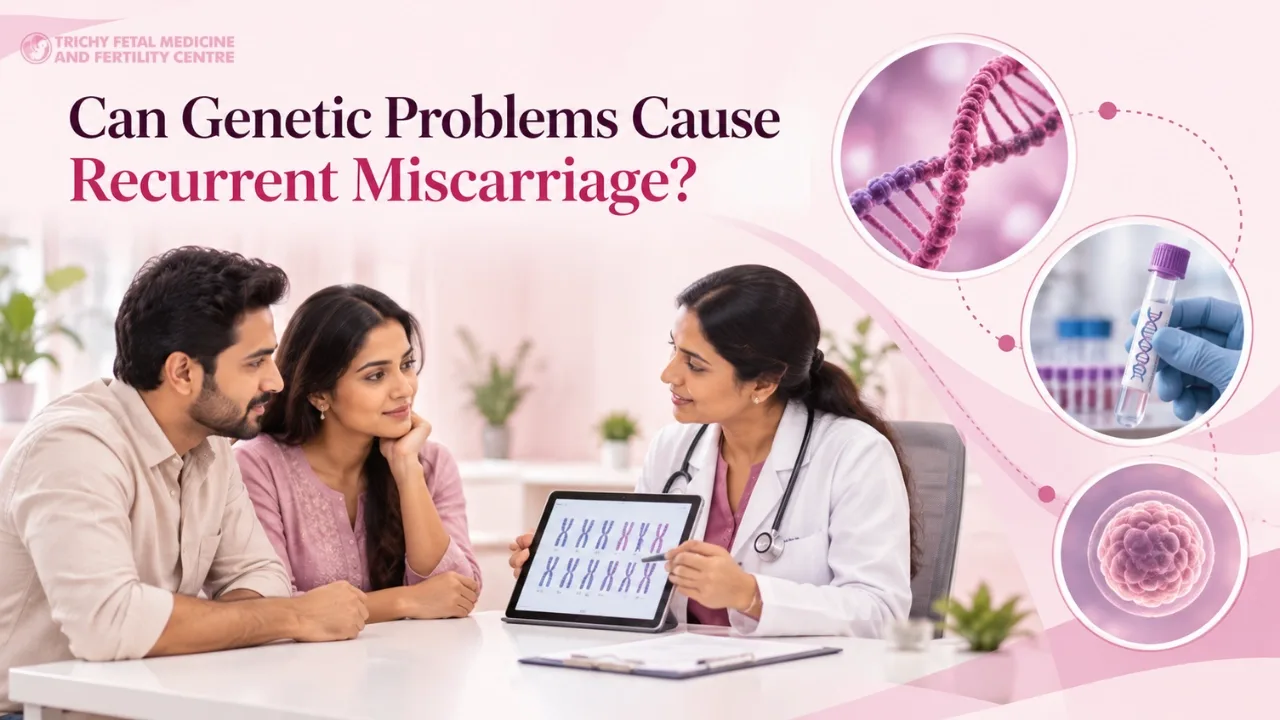
When couples face repeated miscarriages, they often ask if something is wrong in their genes. The honest answer is that genetics plays a major role in miscarriage, but in most cases it is a chance event, not something inherited from the parents.
Humans have 46 chromosomes in 23 pairs, half from each parent. If an egg or sperm carries an extra or missing chromosome, the embryo usually cannot develop, and the pregnancy ends. This type of error becomes more common as a woman ages, and is the main reason miscarriage risk rises after 35.
These happen at conception and are not inherited. They usually do not repeat, which is why most women who have had a miscarriage go on to have a healthy pregnancy.
One partner has a balanced translocation, where parts of two chromosomes have swapped places. The parent is healthy because no genetic material is lost, but their eggs or sperm may carry too much or too little, leading to miscarriage or a child with an abnormality. Inversions and other rearrangements are rarer.
A balanced translocation is found in about 2 to 4 percent of couples with recurrent miscarriage. It is more likely in couples with three or more losses, or with a family history of miscarriage, stillbirth or children with birth defects.
A blood test that looks at the chromosomes of both partners. It is not routinely advised for all couples, but may be considered after repeated losses, particularly if tissue testing shows an unbalanced rearrangement.
Chromosome analysis (karyotype or microarray) of the products of conception shows whether the embryo had an error. If it did, the loss was probably due to chance, which can be reassuring.
You will meet a genetic counsellor to discuss:
Many couples with a balanced translocation still have healthy children, with or without IVF.
For couples with a known parental rearrangement, PGT-SR can reduce the chance of miscarriage. For unexplained recurrent miscarriage without a known rearrangement, routine PGT for aneuploidy has not been shown to increase live birth rates in all studies, and is still debated. Discuss with a specialist.
No. Other causes include uterine shape, antiphospholipid syndrome, thyroid disease, diabetes, infections and lifestyle factors. Many cases remain unexplained.
Seek advice if you have had two or more miscarriages, a loss after a heartbeat was seen, a stillbirth, a child with a birth defect or a family history of genetic disease.
Finding a genetic reason can bring clarity and a plan. And when the cause is chance, it brings hope. For counselling and testing, consult Dr Malathi G. Prasad, a fetal medicine specialist at Trichy Fetal Medicine and Fertility Centre in Trichy.
For appointments, the genetic counselling page has the details, and our fetal medicine specialists can advise whether it fits your situation.
This guide is for general information and does not replace a consultation with a fetal medicine specialist.
In line with the PCPNDT Act, we do not perform or support sex determination.
Genetic Counselling
In-house counselling that explains results, inheritance, and your options in clear language.
Card 1 of 3
Call us, message us on WhatsApp, or send a request and our team will call you back to schedule your visit.
Mon - Fri: 9:00 AM - 9:00 PM